Spirited Arts Competition Gallery – Animal Theme 2025
For the third year running, VinE (Veganism in Education) and the Animal Interfaith Alliance (AIA) have proudly sponsored an Animal Theme in the Spirited Arts Competition, run by NATRE in partnership with RE Today.
Following the incredible success of previous years, this year’s entries have once again demonstrated exceptional creativity and insight, showcasing the imagination, empathy, and thoughtfulness of children from across the globe.
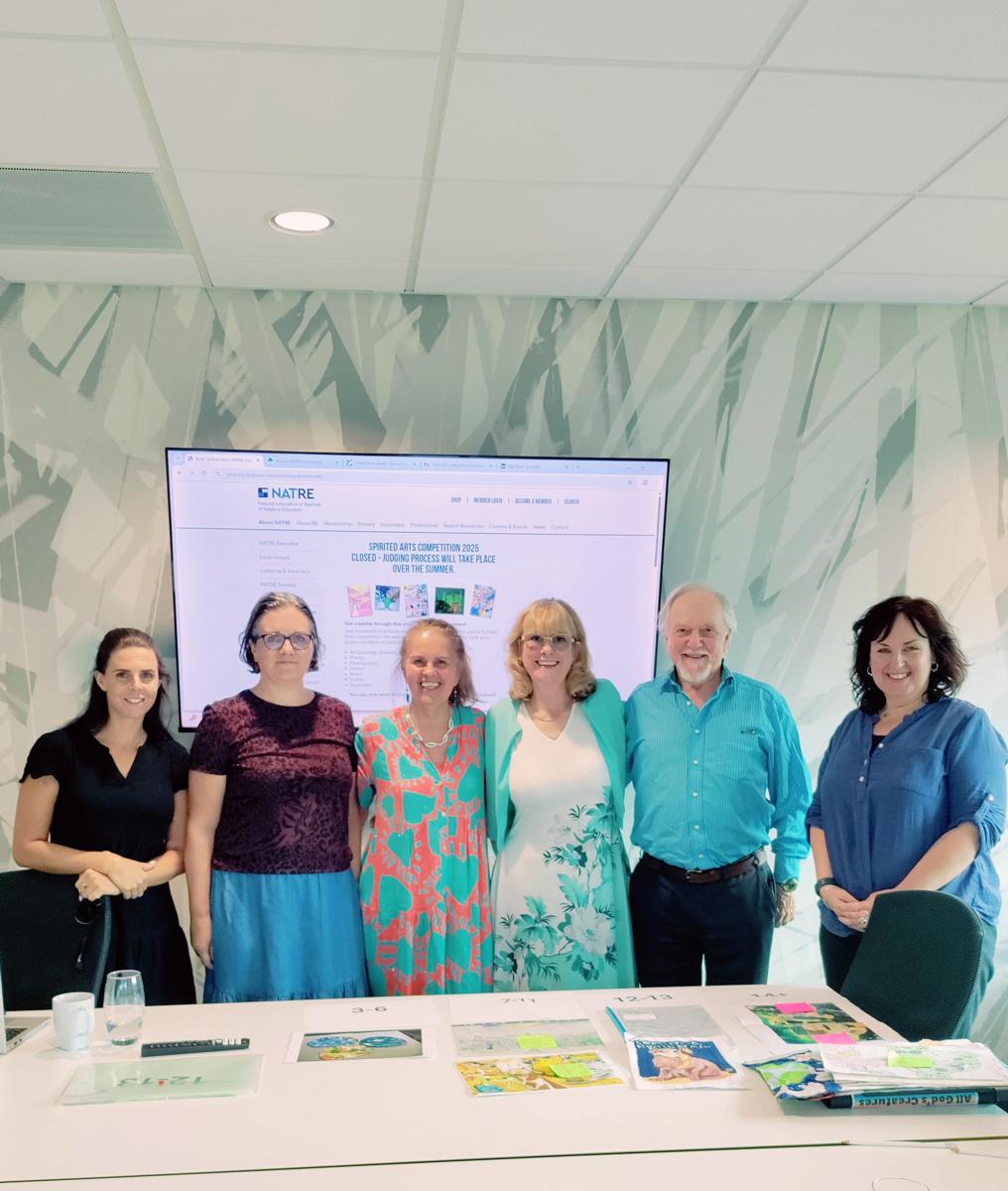
Judging Day in Birmingham
The founders of AIA and VinE, joined by our Patron Dr Richard Ryder, once again travelled to RE Today’s headquarters in Birmingham to judge the entries.
We were thrilled to meet the key members of NATRE and RE Today, who joined us in reviewing the submissions. It was a long, inspiring day — and this time, we even remembered to take a photo!
The entries showed incredible thought, compassion, and courage. Children questioned, reflected, and reimagined our relationship with animals in ways that were truly heartening.
From the left:
- Linzey Tolan, Support and Service Delivery Manager, RE Today Services/NATRE
- Sarah Dennis, Primary RE teacher and NATRE Execute Member
- Michelle St John, Founder VinE
- Barbara Gardner, Founder AIA
- Dr Richard Ryder, President AIA /Patron VinE
- Angela Hill, NATRE Director
Guest Commentator: Dr Nayana Shah
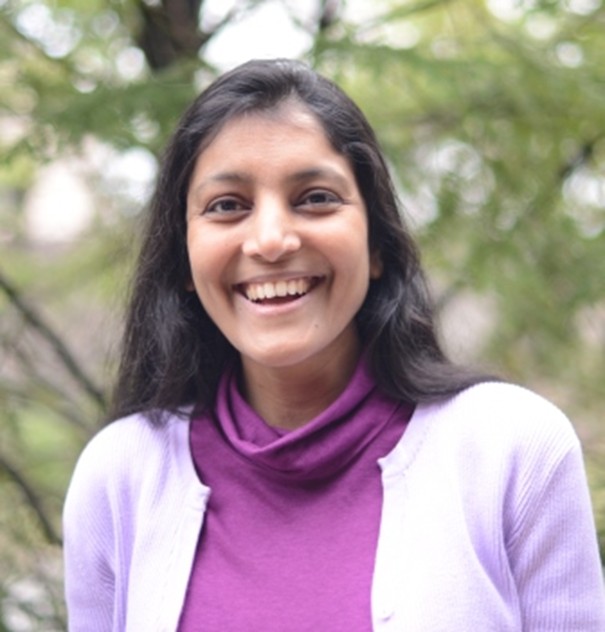
We were honoured to welcome Dr Nayana Shah, Patron of the Animal Interfaith Alliance, as our guest commentator.
Dr Nayana Shah
Dr Nayana Shah is an international scientist – a theoretical quantum physicist – dedicated to living a conscious, compassionate and creative life illuminated by a constant inquiry of truth. She has a wholistic plant-based and ahimsic lifestyle (rooted in her Jain upbringing) and is a long-term vipassana meditator as well as a yoga and non-violent communication practitioner/teacher/facilitator. She has founded and led several initiatives in diverse spheres and settings, is involved in grassroots activism and regenerative movement, and her work spans from the local to the global level. She serves on the Environmental Advisory Board of the City of Cincinnati, the Agriculture Education Advisory Board of the Cincinnati Public Schools, on the board of the Cincinnati Permaculture Institute and as a trustee on the board of Parliament of the World’s Religions. Dr Shah is also a Patron of the Animal Interfaith Alliance.
Reflections from Dr Nayana Shah
“I have always known that children take us further along the path of truth. However, most systems are sadly set up such that adults make all the calls, and judge children mainly based on how well they follow their instructions.
So, when I found out about the Spirited Arts Competition, I thought that it was such a wonderful opportunity for children to fully express themselves with their heads, hearts, and hands coming together in harmony; and for adults to pause and receive what the children have to offer.
But I didn’t realize that what I was about to witness would move me to tears. I could feel the raw sadness and disappointment of the children for the state of the world in which they find themselves, so poignantly expressed through diverse art styles and mixed media paired with powerful words, often noting a disconnect with the spiritual teachings of love and compassion for all beings.
At the same time I was deeply touched by their imagination and their use of metaphor, irony, contrast, symbolism, and other creative ways to communicate the tender visions in their hearts. These children, from elementary to high school, all unequivocally communicated a worldview in which humans are not superior nor separate from other beings and all creatures big and small that make the rich tapestry of life are essential and precious. My heart filled with gratitude for these children and their ability to transmute grief into grace and hope. I felt the presence of “all god’s creatures” in the beautiful works I was beholding.
Let me take this opportunity to celebrate the ethical veganism resources of ‘RE Today’, that have helped validate and nurture what children innately feel and understand: everything in the universe is fully interconnected and all of life is sacred. Empathy and compassion naturally follows from this core truth and it shines through all the artworks. This truly spirited art is the way to awaken and transform our world through the deeply creative wisdom of children.”
2025 Gallery
Discover the extraordinary creativity and insight shown in this year’s entries.
These young artists explore big questions about justice, compassion, belief, and responsibility. Through Religious Education, they are developing the confidence to think critically, respond with empathy, and imagine a kinder, more connected world — for all beings.


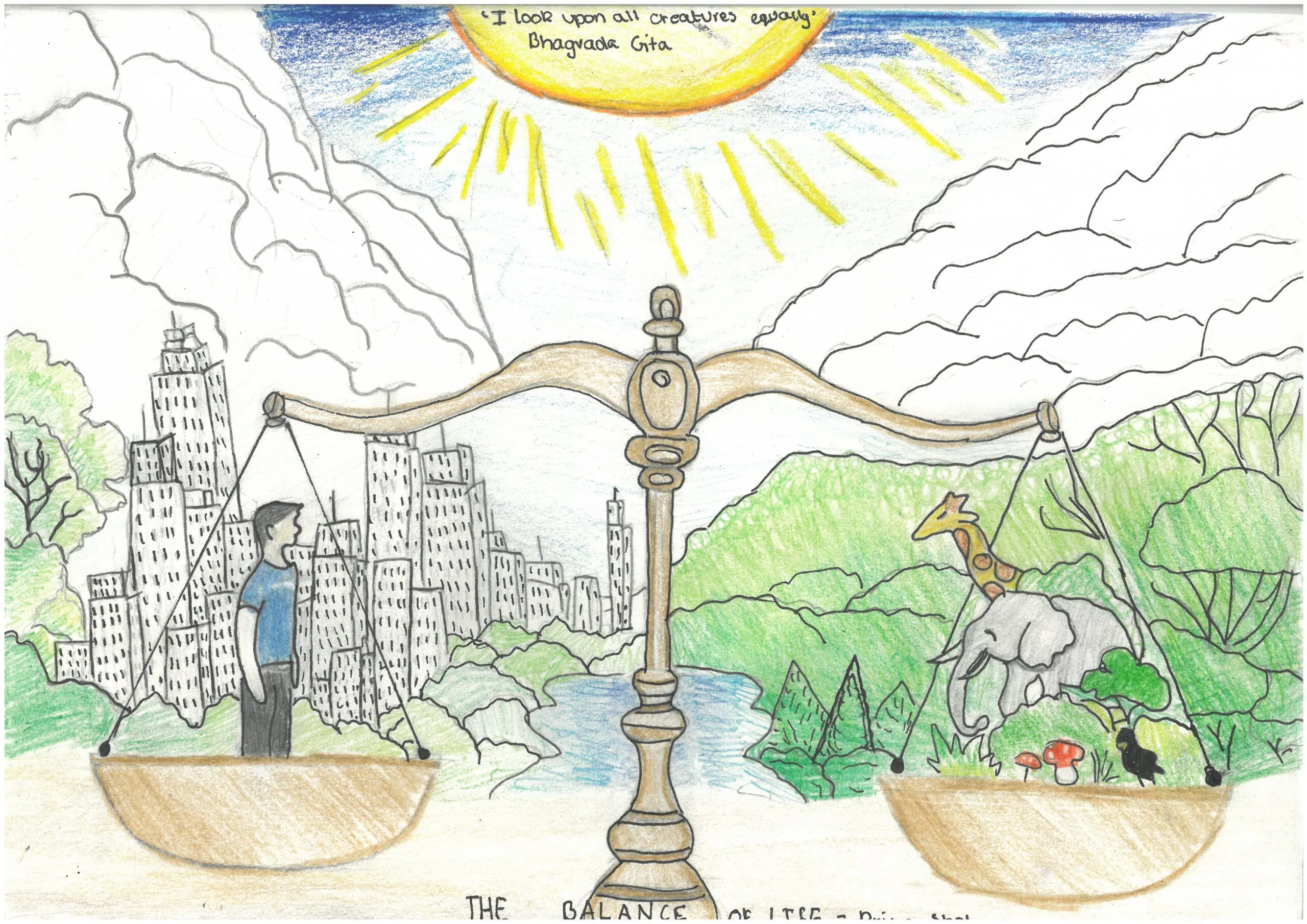
Priya – Age 11 – The Balance of Life
St Helens School
The quote I chose to inspire my artwork is, “I look upon all creatures equally.” -Bhagavad Gita. This means that every living being, whether human or animal, is seen as equal in the eyes of a divine being or God. I believe this shows how important it is to treat animals with care and respect because they are equal to humans.
In my picture, I drew a large sun in front of the scales to represent God or a divine being. On the scales, I placed a human on one side and different animals on the other, including an elephant, a giraffe, and a bird. The scales are perfectly balanced, which shows that animals and humans are equal; they both matter just as much as the other.
While making my artwork, I was thinking about the question: Do animals have souls like we do? In Hinduism, they believe in reincarnation, the samsara cycle. This is when the soul (atman) lives a life, and when it dies, it gets reincarnated into a human, bird, or animal depending on how much good or bad karma it has. Eventually, if someone builds up only good karma, they can reach moksha, which is freedom from the cycle. This shows that all life is connected, and animals are part of this cycle too.
In Christianity, it says that humans were told to “rule over” the animals. I think this doesn’t mean we should exploit them or destroy their habitats. Instead, I believe it means we should care for and protect them. Some people think humans are more important than animals, but I believe that all life has value.
The message I want to share through my artwork is that animals are just as important as people, and they deserve kindness and respect. The sun in my picture shines on everyone, showing that a divine being would care for all creatures equally.
Elizabeth College
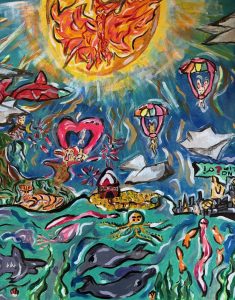
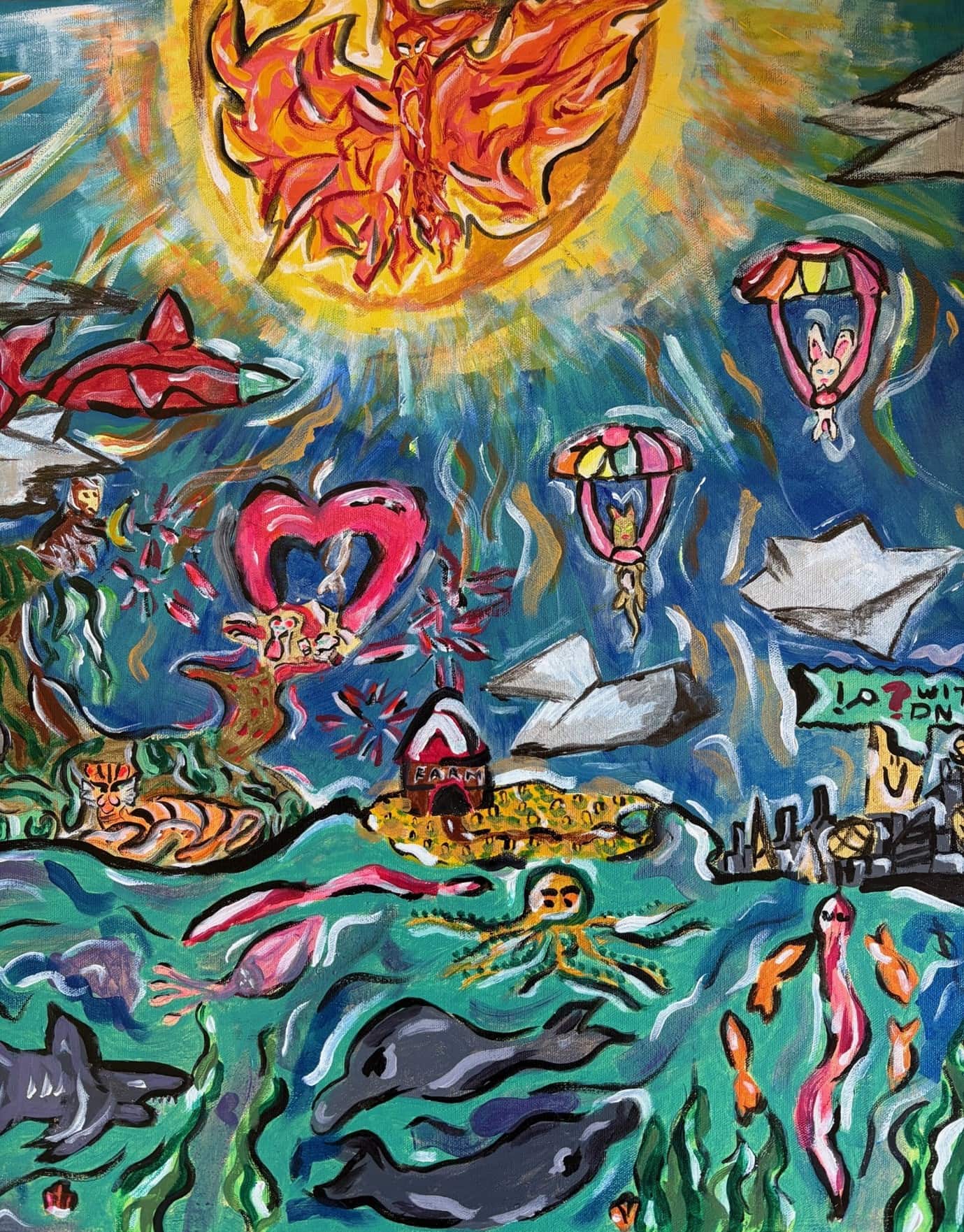
The central theme of my artwork was exploring the view of some religions that perceive humans as being more important than the other animals of this Earth.
In my painting, there are no humans. The world is depicted with only animals. Some animals are in their natural habitat, like the tiger in the jungle, or the sea life below the surface. Other animals are shown as having anthropomorphic characteristics, whether it is mice getting married, animals flying airplanes, farming, living in cities or even parachuting for leisure.
Additionally, no animals are shown as being more important than others. I have tried to show this throughout the painting by showing that predators and prey co-exist together.
Both the cat (predator) and rabbit (prey) can do the same activities. The tiger and monkey are both content in the jungle. In the sea, all the animals co-exist peacefully.
Even my depiction of God is replacing the more traditional view of God as a “Human-like Father” with that of a Phoenix. The power of the Phoenix creates the sun which gives life to all creatures on this Earth.
Using a phoenix as God in my painting also serves another purpose. Phoenixes are associated with rebirth, resurrection or reincarnation, which is a fundamental aspect of religion. When I worked on this painting, I asked myself “What would the world look like if there were no humans?”. My painting shows a world that is brighter, cleaner and happier without the influence of humans.
In Genesis 2:15, the scripture says: “The Lord God took the man and put him in the garden of Eden to work it and take care of it”. Christianity, as well as other religions such as Judaism and Islam focuses on how humans should be the stewards appointed by God to take care of the Earth and all its creatures. I feel that we have failed to take on this responsibility. My painting is a reminder that if we treat animals as equally important to us and take care of all life, we will make the Earth the paradise that the Garden of Eden was always meant to be.
TK IT Abata Lombok II
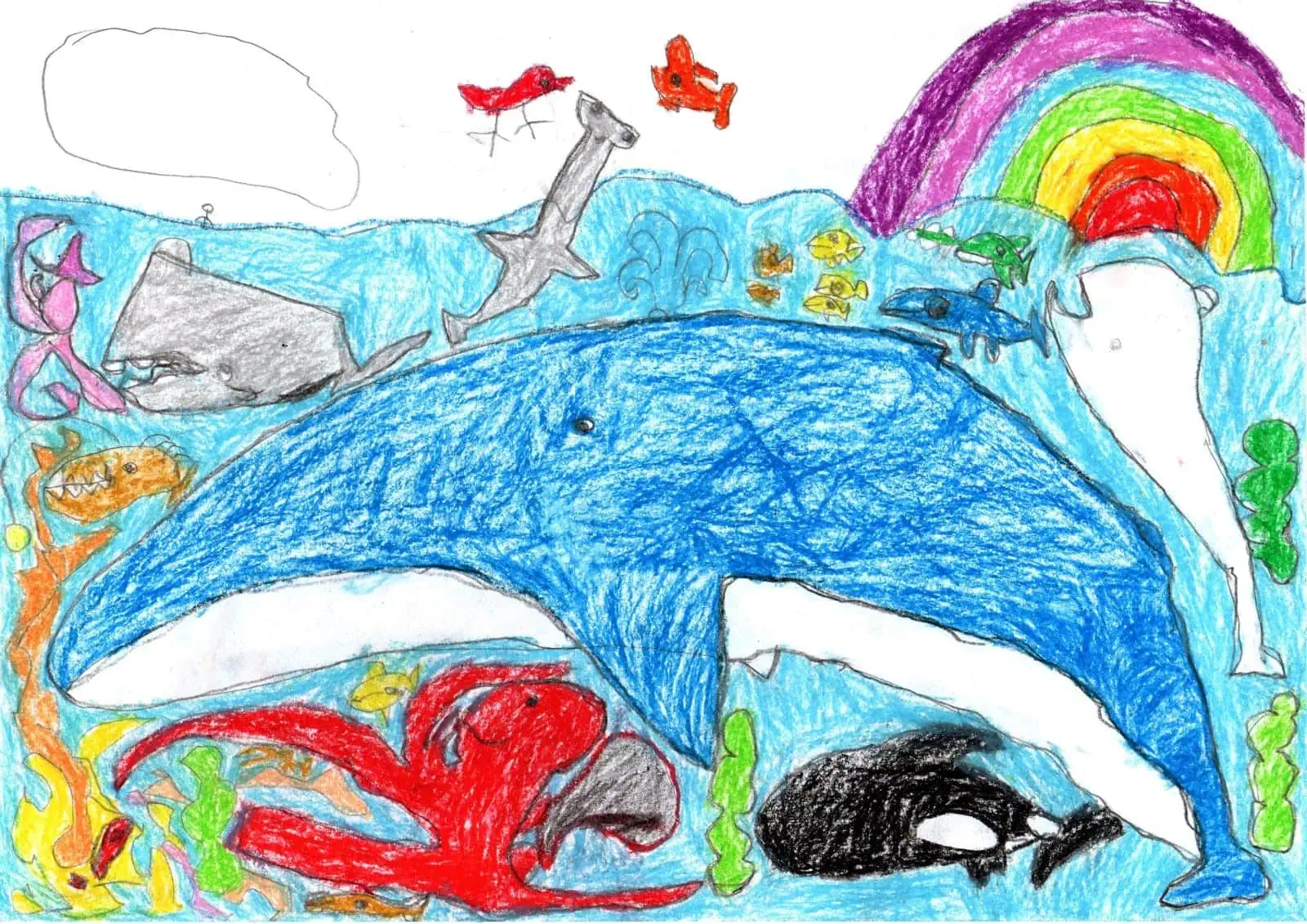
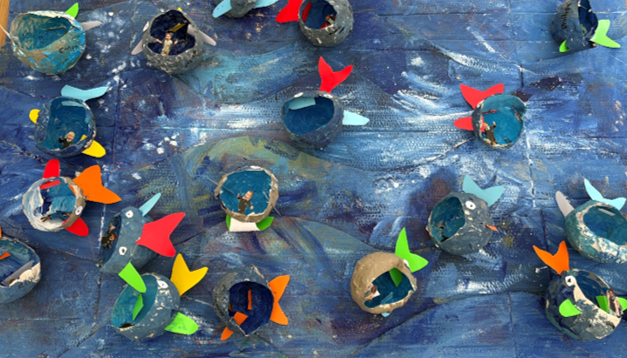
Haii, I’m Keyaan, I’m 4 years old, I’m a student of TK IT Abata Lombok II. Prophet Yahya AS was a very special child. He deeply cared for all living creatures. If he saw a friend hurting an animal, he would stop them and give kind advice. He shared his food with animals and birds, and he preferred to eat fruits from trees. Prophet Yahya taught that all creatures, including animals, are God’s creations and should be cared for and protected. My artwork shows the life of small fish and animals, the beauty of nature and how happiness can also be found in their natural habitat.
Solihull School
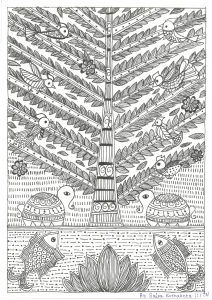
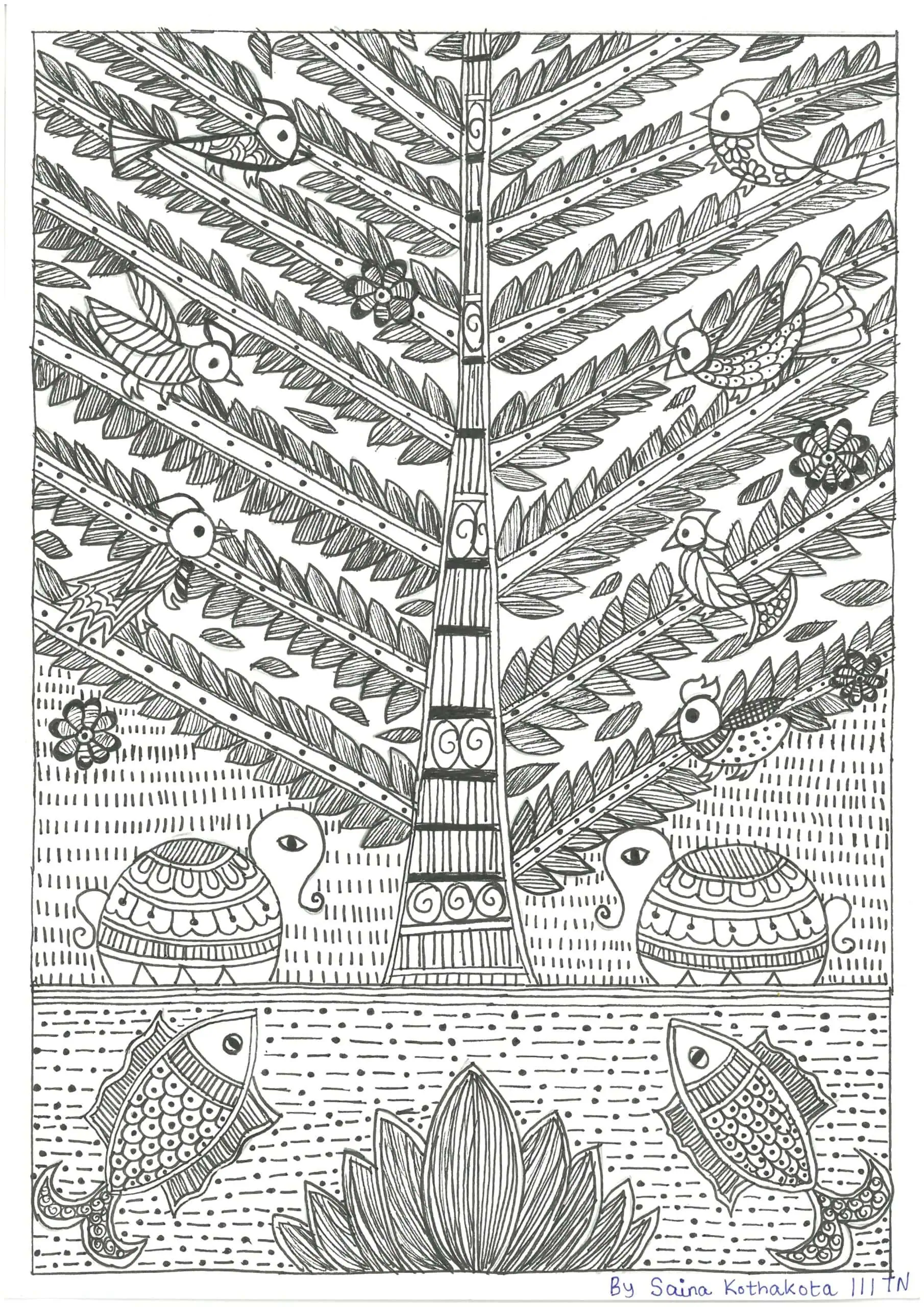
In every faith around the world, the message of love, care and respect for all is central. Whether it’s a bird fluttering, an elephant walking or a human on a path, all are part of Gods creation. I have used a traditional Indian art form called Madhubani. It uses symmetrical patterns, vibrant colours and is connected with mythology. I used it to show harmony and peace in the scared life on Earth. ‘The creatures shown convey the idea that all are in unity and are connected. The tree shows balance, its branches stretch wide, offering shelter and space for animals and plants. The repeated patterns show that creation is endless. The book of Genesis shows that God created life and it was good. In Hinduism, ahimsa teaches non-violence and that life is sacred. The message is crucial, we must care for the wonderful life that God created. Earth belongs to all.
St Johns Middle School
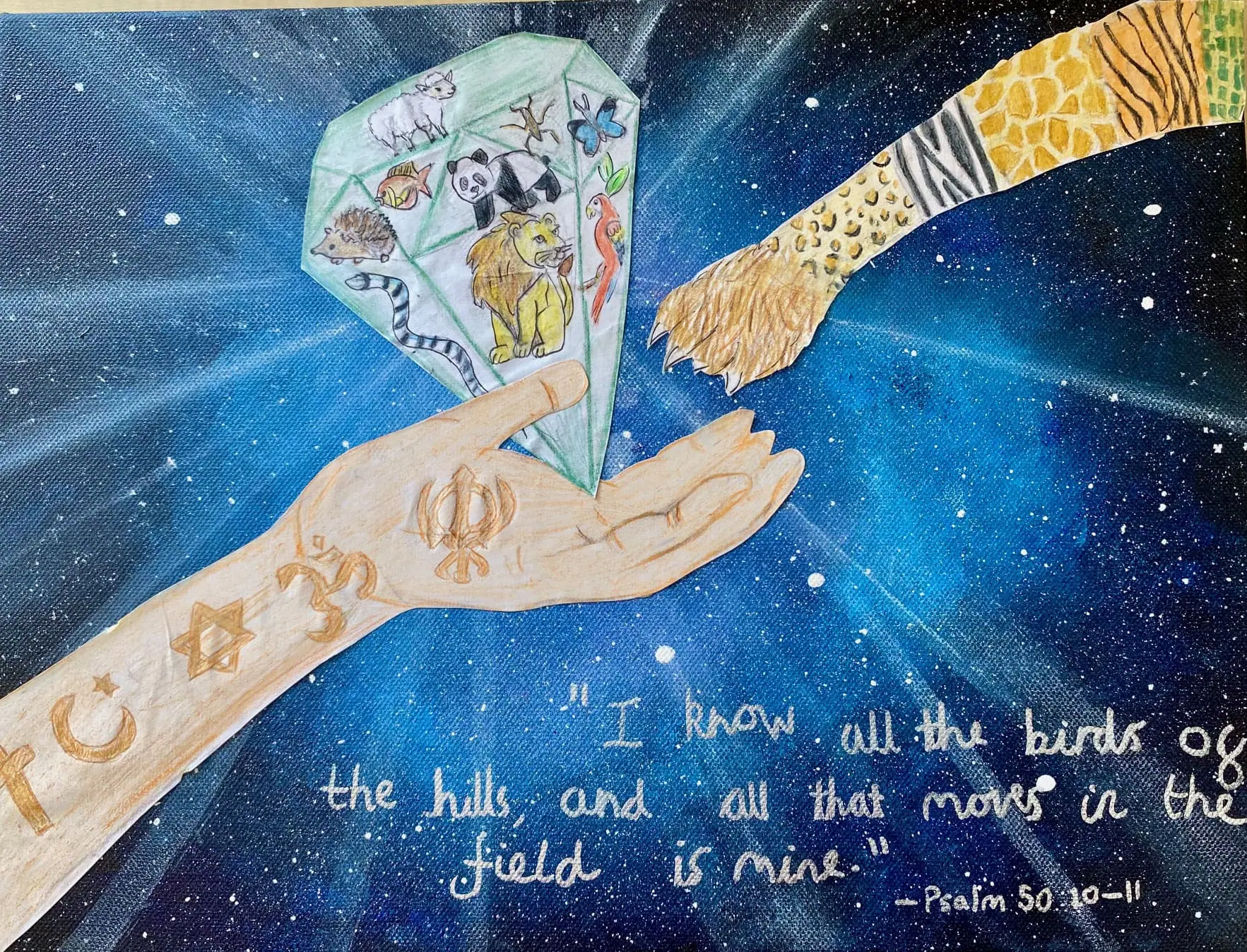
I chose the title Heaven’s Handshake because I wanted to show that humans, God and animals are all linked. I have always loved animals and I started to think about how I could link religious beliefs and world views to my own. I wanted to symbolise the human and animal connection by drawing an animal paw reaching out to a human hand.
The animal paw has many different types of fur or skin patterns to represent all animals. The human hand has some of the different world religious symbols to show that this connection is across all faiths. I also wanted to show that God trusted humans to be responsible for animals, but they still ultimately belong to God as creator, like the quotation from the bible that is in my work. I thought about ‘gifts’ and decided to show animals inside a precious gem, given by God to humans. The light from the gem represents the Sikh idea that God’s divine light is present creatures. I thought it was important to include different species of animals in the gem – large and small and also animals that we consider food and those we don’t. I hope it makes people think about whether all animals are equal yet humans do not treat them equally.
Sholden C of E Primary School
Stretford Grammar School
My work explores how everyone knows that the world was created by something, some huge force that may be God, or the Big Bang theory, or something very different. We, humans and creatures, were all created by the same huge force and therefore I think that we are all of equal value. I drew lots of animals to show that they all live with us on earth and they live in harmony with each other which is really beautiful. Maybe whatever created life on earth wouldn’t be happy with us for causing animal extinction and death on this planet, especially as we understand so little about the cause of universal life.
All animals deserve to be able to live their own lives naturally, and not be eaten or captured or killed because of us.
In the image there is a goldfish, a blue morpho butterfly, a giraffe, a boomslang snake, a glass frog, a garden snail, a tabby cat and a yellow warbler bird. I think that they all are a really pretty species with interesting colours and patterns. It is amazing how all of them are born looking like they do and have evolved just like we have to suit their environment. It shows how incredibly diverse the world is and how many different creatures in the world there actually are, which is why we need to protect it as much as we possibly can.
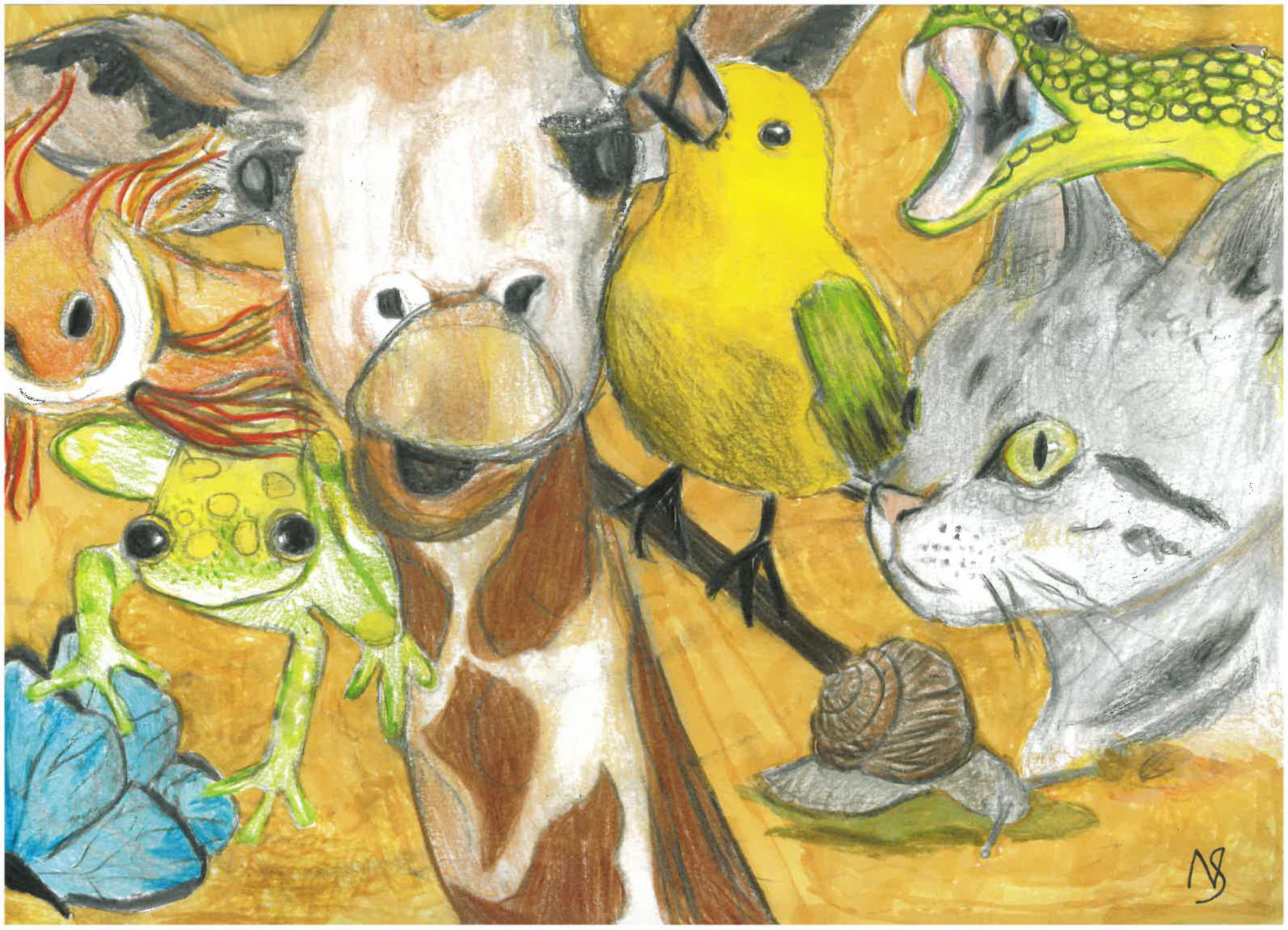
Zafirah – Age 14 – All God’s Creatures
Sutton Coldfield Grammar School for Girls
“Were we incapable of empathy – of putting ourselves in the position of others and seeing that their suffering is like our own” then ethical reasoning would lead nowhere. If emotion without reason is blind, then reason without emotion is impotent.” Peter Singer, Writings on an Ethical Life (2001)
Animals in this world are constantly being slaughtered, tortured, and held against their will but if “Everyone in the world is equal. All beings and creatures are His; He belongs to all.” (Guru Granth Sahib 425) then why do we treat them as though we are higher beings, as if they can’t feel the pain we do, as if these animals are just at our disposal. What if it was the other way round? What if we were the ones being held by a leash, collars strapped to our throats, what if we were the ones not given the right to consent and have tests forcefully done on us.
That is what my painting aims to depict.
Animals and humans in reverse.
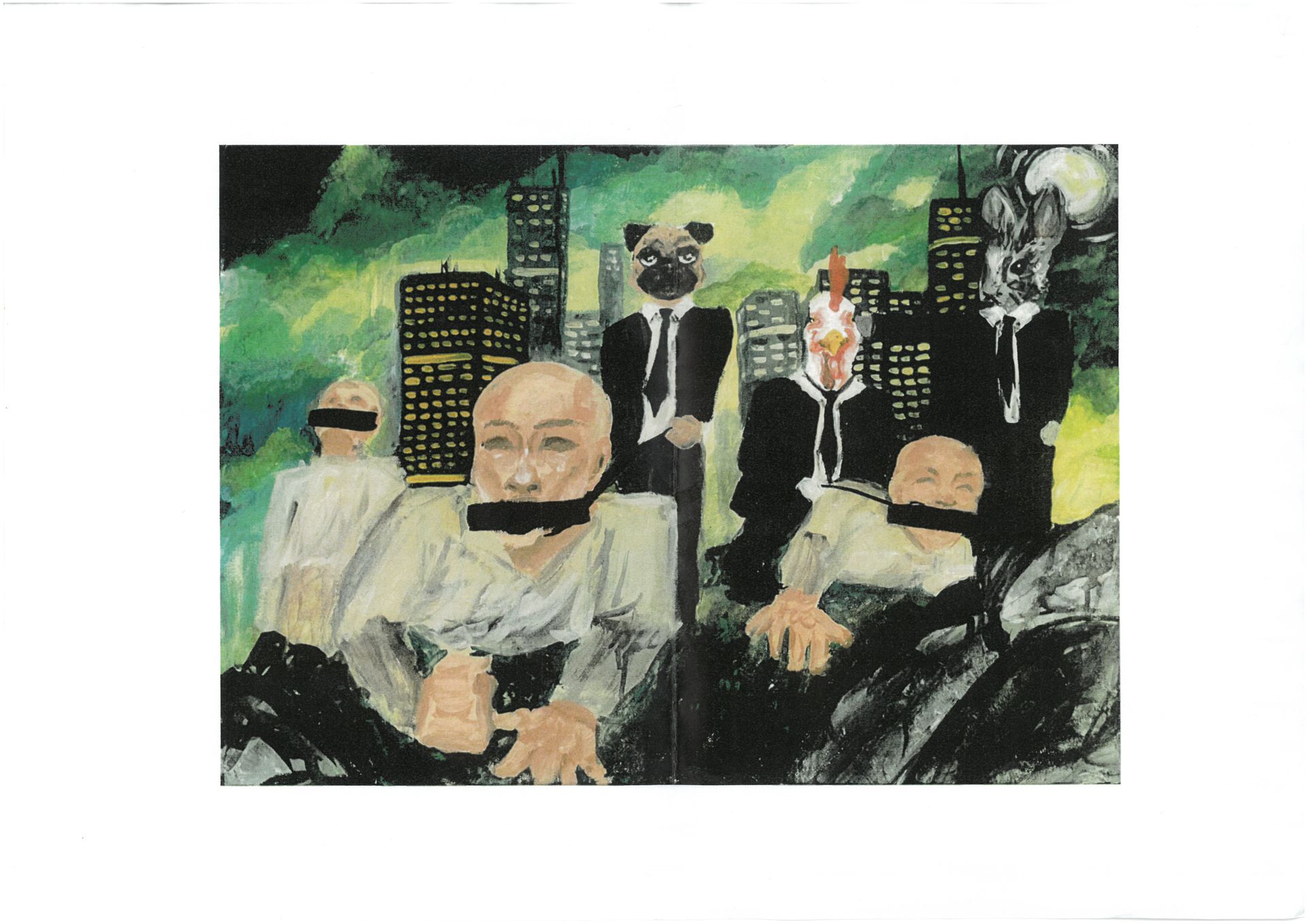
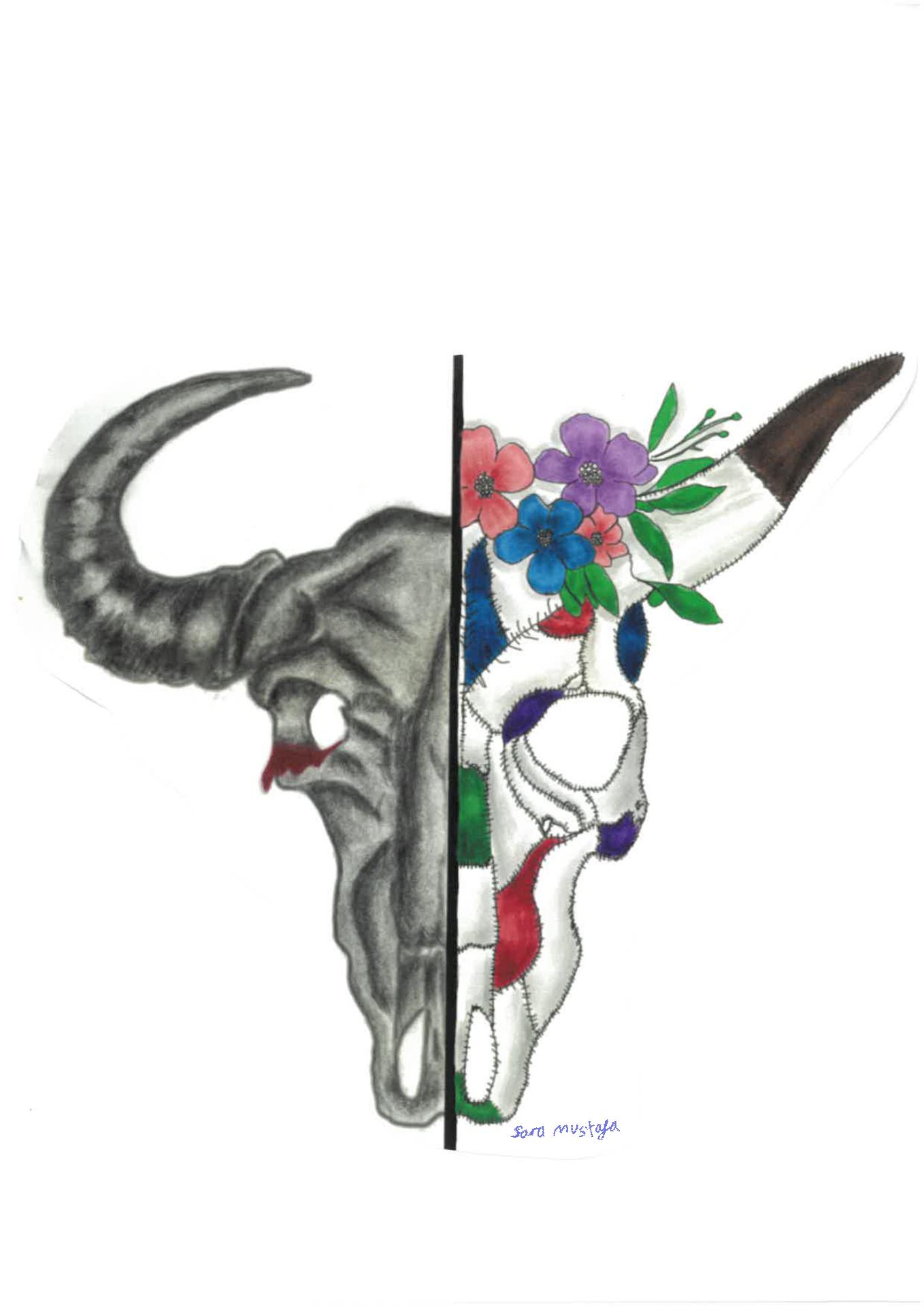
Sara – Age 12 – But can they suffer?
Blackheath High School
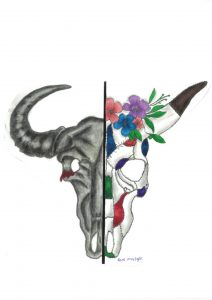
All God’s Creatures. What does that mean? If you had asked me before I drew this piece of artwork, I would have said, the animals. But, through doing this, I have realized that it means so much more than that. Sure, we are flesh, blood, and bone, but it is the emotions we feel and how we choose to live our lives that define what a creature is. Does it really matter if you think to yourself, that animal looks ugly so it can die? Because that is not fair. It’s not right, so we shouldn’t treat creatures like objects we can use for our own greed. You may not think too deeply of it, but the creatures can feel pain too. Animals have lives, and when we give these lives a chance to thrive, we can see how the creatures of the earth are a gift from God. After all, we share the earth, so let’s stop and think before we act, before we destroy the peace of the animal kingdom. We will find a way to live in harmony, even if it takes every little stitch to sew a path to a world of united species. There are people who will stand with the belief of animal equal rights. This is proven by the quote of Peter Singer, where he said, by ceasing to rear and killing animals for food, we can make so much extra food available for humans that, properly distributed, would eliminate starvation and malnutrition from this planet. Animal liberation is human liberation too. Extreme poverty is not only a condition of unsatisfied material needs. Jeremy Bentham, in his work, notably said, the question is not can they reason, nor can they talk, but can they suffer? In response, I would completely agree with these words. Not only do they state the truth, animals can be in agonizing pain, but we also see their rights are being fought for. This is what I choose to represent in my digital drawing. The grey skull represents the brutal reality of cold and cruel animal slaughter, but the other half stands for the idea that we can come past this and patch together a new life to a life entwined with these beautiful gifts from God.
St George’s School
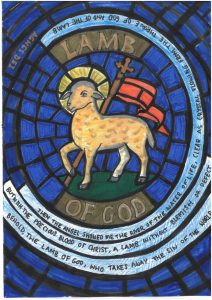
Many people, Christian or not, know the term ‘Lamb of God, who takes away the sins of the world’. After researching, I realised how often the lamb is mentioned in the Bible. I decided that if God thought the lamb (an animal) is worthy enough to be compared with Jesus, animals must have an important role in God’s eyes. For example, in the stories of Moses and Abraham, a lamb is killed and sacrificed in the place of someone else. This is similar to Jesus when he died on the cross to save us. Often you hear about the lamb being seated at the right hand of the father just like Jesus, this is another examples of how the lamb is similar to Jesus. In conclusion, I chose to draw and write about the lamb because their value and importance is shown throughout the Bible in stories from Jesus, Moses, Abraham and more.

Wren Academy Enfield
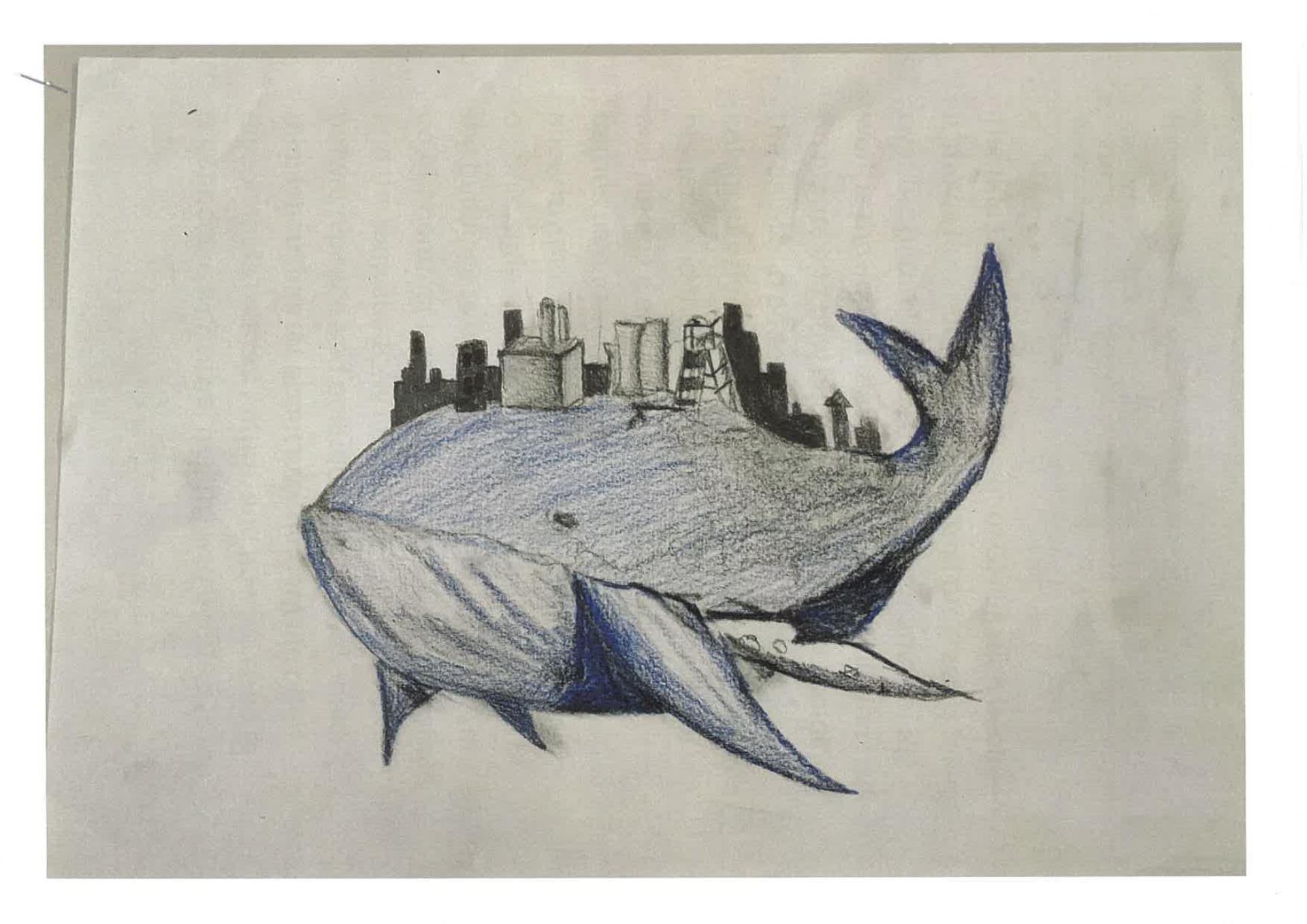
The title I chose is The Weight of Civilisation because it shows how humanity’s industrial progress is taking over the natural world. The deeper meaning of my work is the impact that the industrial revolution had on nature and how humanity in general is exploiting the calm and peaceful natural world. This links to spirituality through the sacred relationship between humans and the Earth. The whale is a symbol of life and placing a city on its back represents how it carries us and how we weigh it down. I have tried to show my thoughts and feelings by blending the organic shapes of the whale with the hard lines of the buildings to create a sense of imbalance. The colour contrast between the cool blue of the whale and the dark shadowy city reflect the tension between peace and pollution. While I was making this, I thought a lot about how modern life often disconnects us from nature, and how we need to reconnect in a positive, healthy way before it is too late
Marlborough College
For thousands of years, humans have relied on animals for food. From ancient hunting tribes to modern industrial farms, meat has been a central part of many diets and cultures and is craved all over the world. However, as society progresses and becomes more aware of the ethical, environmental, and health implications of our food choices, the practice of killing animals for food is increasingly being called into question.
The backstory of animal consumption starts in prehistoric times when early humans hunted for survival. Meat provided vital nutrients and energy that helped human populations grow. Over time, domestication of animals led to more consistent access to meat, milk, and eggs, shaping agricultural societies. Meat also became associated with wealth, status, and tradition, especially in Western cultures.
Despite this deep historical connection, modern industrial meat production has raised serious ethical concerns. Animals on factory farms often live in overcrowded, unsanitary conditions. They are frequently subjected to painful procedures without anaesthesia, such as debeaking, tail docking, and castration. The slaughter process itself can be inhumane, with some animals remaining conscious during their deaths due to high-speed processing lines and insufficient oversight. These practices not only cause immense suffering but also strip animals of their natural behaviours and dignity.
Beyond animal welfare, there are significant environmental consequences. Livestock farming is a leading cause of deforestation, particularly in the Amazon rainforest, where land is cleared for cattle grazing or growing feed crops like soy. The industry also contributes heavily to greenhouse gas emissions, especially methane from cows, which accelerates climate change. Additionally, meat production consumes vast amounts of water and contributes to pollution through runoff of waste and chemicals into waterways.
Health is another concern. Overconsumption of red and processed meats has been linked to heart disease, cancer, and other chronic illnesses. Meanwhile, antibiotic use in livestock can lead to resistant bacteria, posing a risk to human health.
In light of these issues, many are advocating for plant-based diets or lab-grown alternatives that do not involve killing animals. While food traditions are deeply rooted, rethinking them can lead to a more compassionate, sustainable future.
By understanding the origins and consequences of eating animals, individuals can make more informed and ethical choices about what ends up on their plates.
Christchurch Primary School
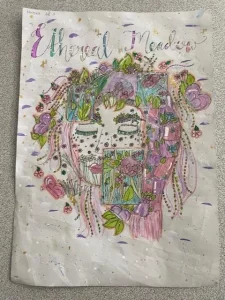
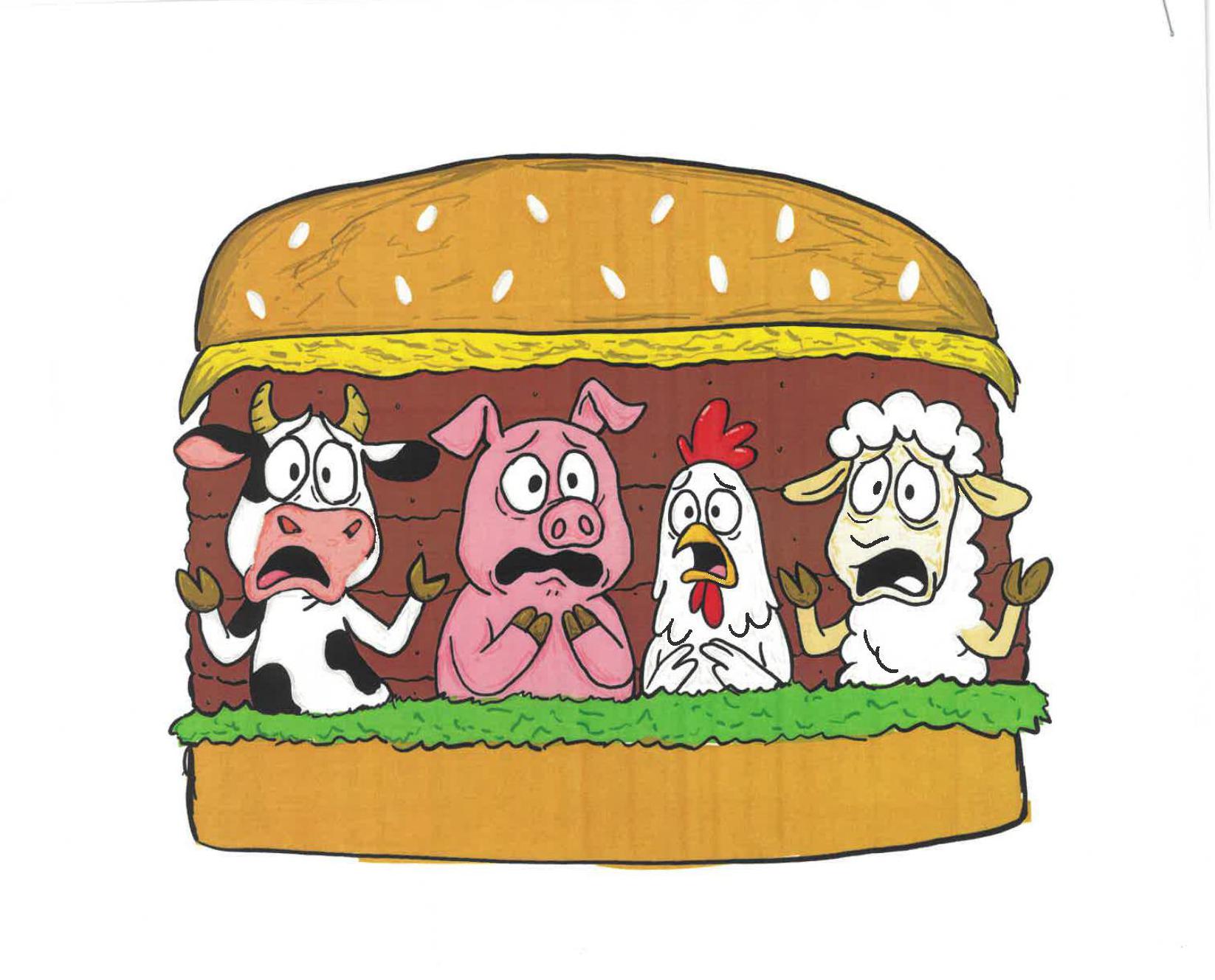
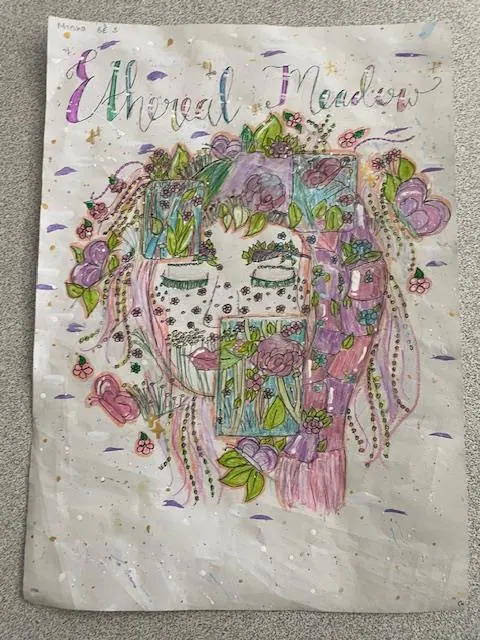
My artwork was inspired by deforestation and pollution. It shows a picture of a woman who has plants and greenery surrounding her, with tears representing the rain that helps our beautiful plants grow and bloom. I chose to draw butterflies around it, because it symbolizes new beginnings, hope, freedom, joy and lightness, which is what I want in our world. My artwork tells people how lucky we are to have animals and nature by our side and that we shouldn’t destroy these divine things. Do they not play a vital role in our lives?
Becket Keys Church of England School
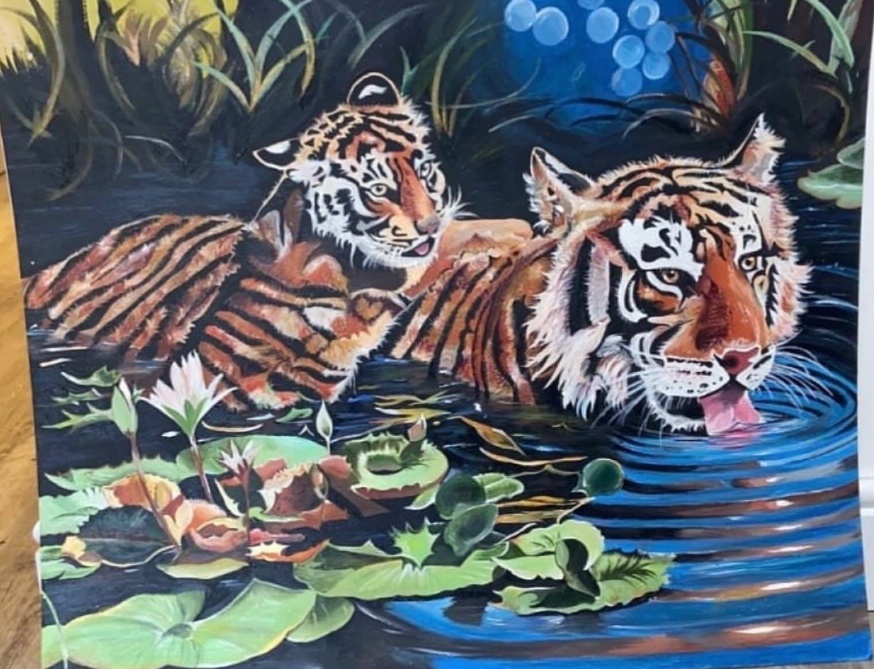
My Image shows a beautiful setting of a family of tigers. My focus was to enhance the details and beautiful shapes of God’s Creatures. I wanted to capture the beauty of nature in all its goodness, the background, the habitat and the Tiger itself. Beaty is all around us in this wonderful world we live in and we need to appreciate and look after it for future generations.
Fairfield High School for Girls
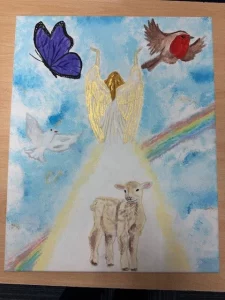
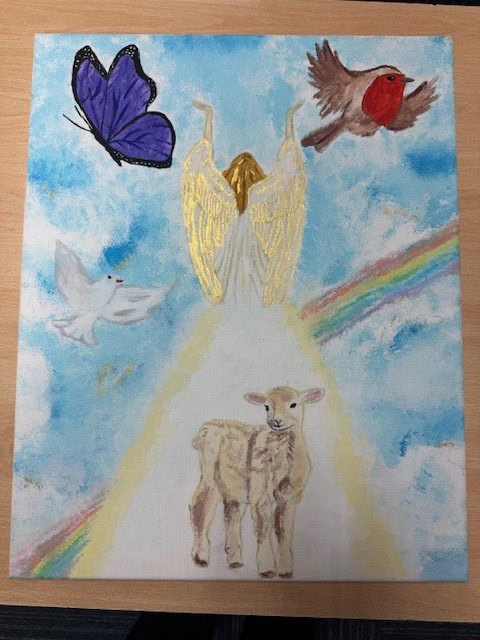
The inspiration for my RS Spirited Arts painting came from my Grandma who loves animals and is very poorly at the moment. The animals I have chosen to draw are linked to traditions of new beginnings, renewal and hope.
My Grandma has a strong faith in Christianity so I wanted to paint the lamb, the angel and the light to represent symbols of Christianity but also to show that God is watching over her and bringing us hope and positivity through the animals around us.
I feel that my artwork is spiritual because I believe animals are connected to God and us in lots of different ways and help us understand difficult times.
My family have a special connection to robins and believe they are messengers from loved ones as are butterflies and are here to bring comfort and peace in times of sadness. I really wanted to include a robin in my picture because two robins have recently nested in my garden and my family and I watch out for them everyday.
I hope people will also notice the dove and the rainbow in the background as they are symbols of hope as well.
This artwork is all about believing that animals show us glimmers of hope in times of need. The whole piece represents the promise that better and brighter times are waiting for you.
Queen Elizabeth’s High School
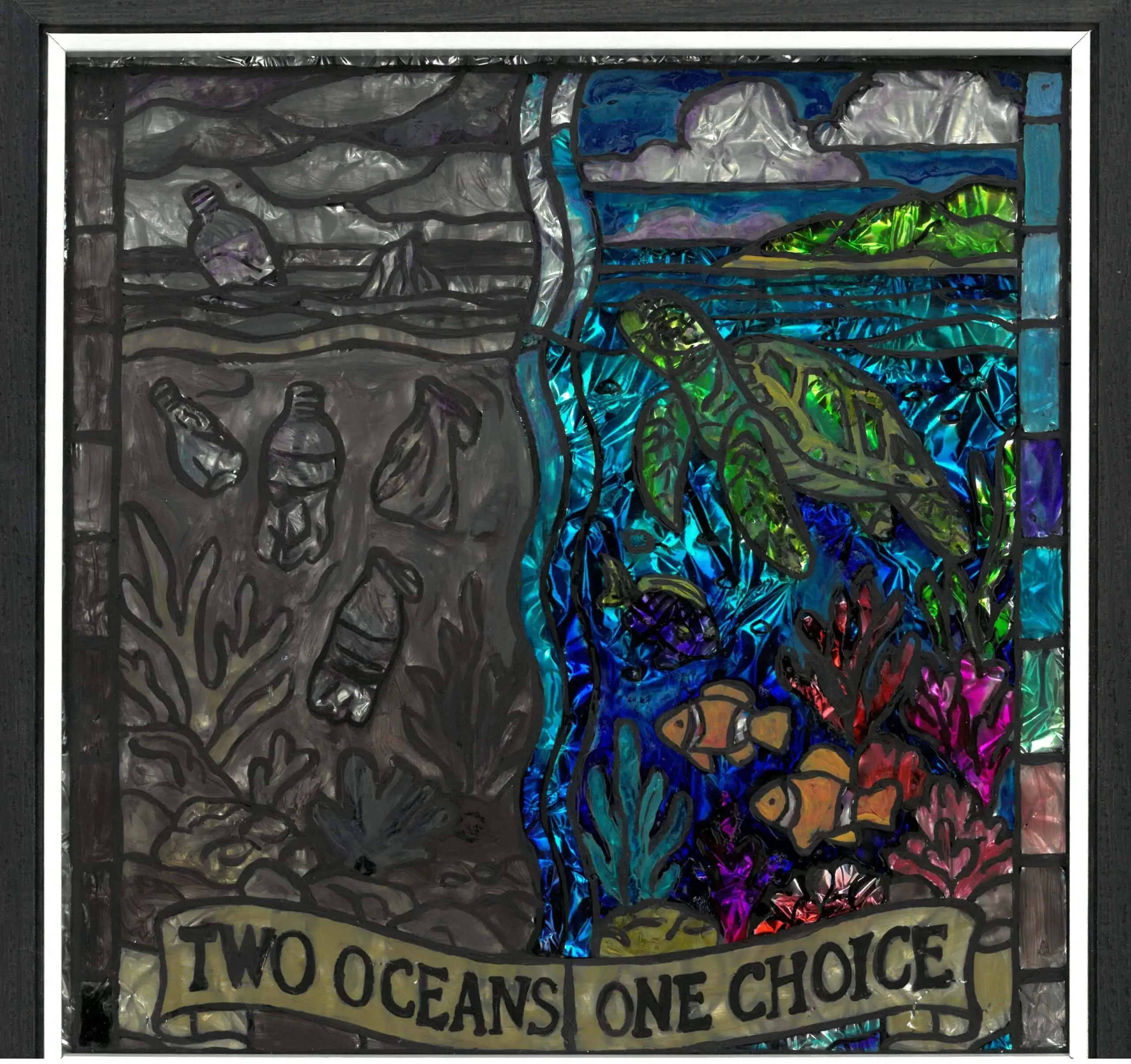
l painted two oceans on glass one dark, still, and empty. No turtle swims there, only shadows and plastic. It shows a world where people forget that animals matter. Some believe humans are above all, but others like in Islam and Buddhism teach that animals are part of a bigger, sacred plan.
Christchurch Primary School
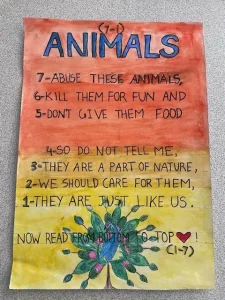
Writing this poem made me think why do people kill and abuse these animals for fun? Instead, they can care for these animals, they are just like us. This poem I wrote was inspired by a poem called ‘Refugees’ by Brian Bilson. It became my favourite poem by the time I finished reading it. It has a very clever message by reading the poem one way and giving a very negative view on refugees, but when you read it backwards it gives a totally different perspective, so I decided to create my own poem using the same method.
My inspiration for my poem came from when I was about 8 years old, when I saw that someone had put an injured, close to dead cat inside a dustbin. It made me feel so angry that someone could do something so cruel to a cat. So now I want the rest of the world to realise all animals are important and need protecting at all costs.
Finally, I added a peacock at the end of my poem as it symbolises the seeking of knowledge as we should seek inside ourselves and protect ALL animals at all costs. ALL animals are beautiful just like peacocks.

Becket Keys Church of England School
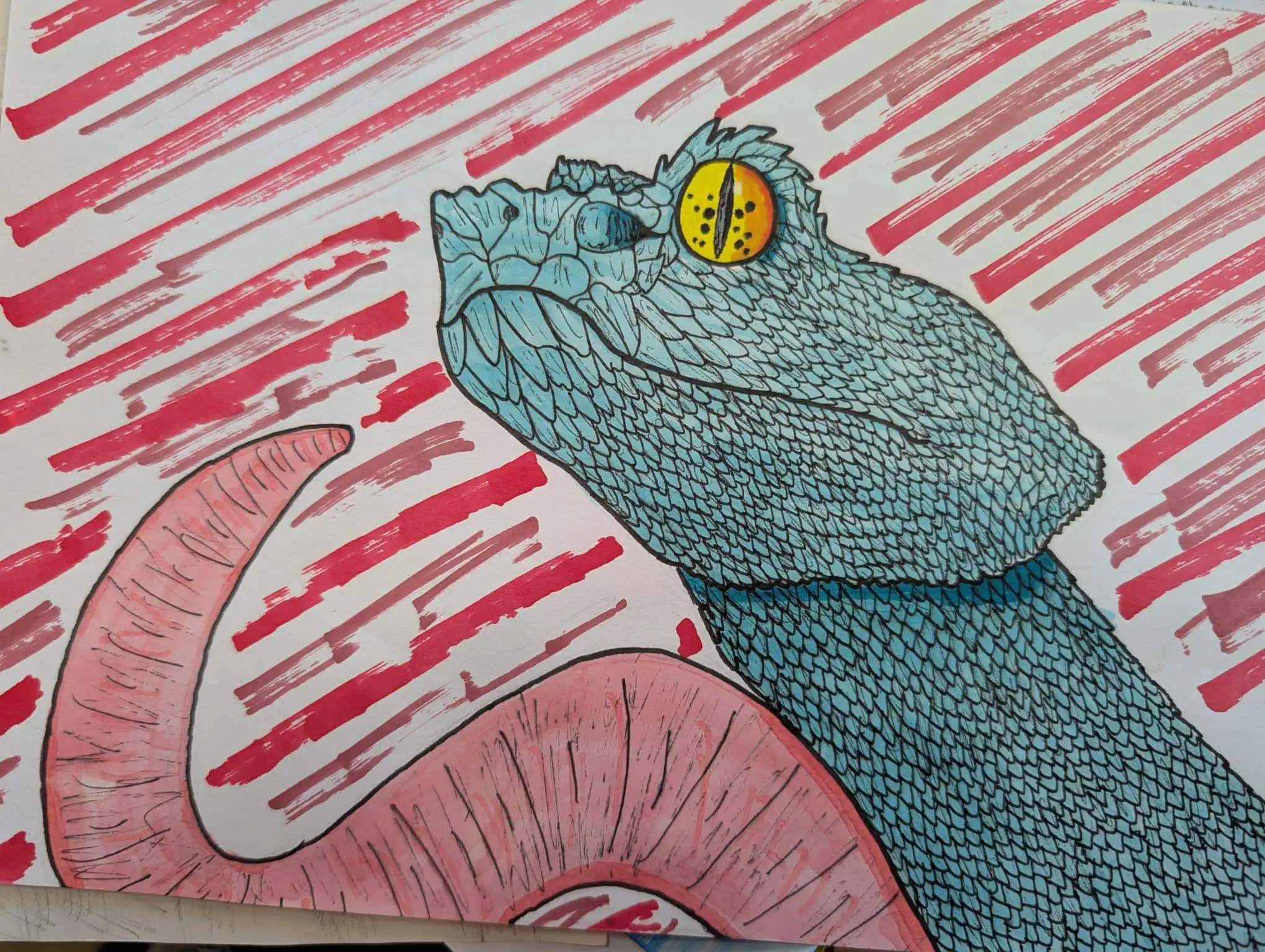
My carefully drawn art piece is a portrait of a hybrid creature: the top half is a diamond blue eyelash viper, and the lower half is an earthworm. The main reason I chose to draw this piece for the topic All God’s Creatures? is because I’ve always loved the scaly patterns of snakes, the slimy texture of earthworms, and the simplicity of drawing hybrid animals. When I was six, I would ask someone to pick two or three animals, and I would carefully draw a hybrid based on their choices. That early experience inspired the way I draw today and helped me develop strong self-improvement skills.
I included a vibrant red background with striped patterns surrounding the snake. I chose this colour because I’ve used it before in my artistic journey and it continues to feel meaningful in my work. The competition has given me a great opportunity to explore new styles, especially semi-realism, while also deepening my understanding of how animals are symbolised across a range of religious and non-religious worldviews. Creating this piece took me 4 hours and 20 minutes, mostly because I drew each individual scale to give it that extra pizazz!
The Trafalgar School at Downton
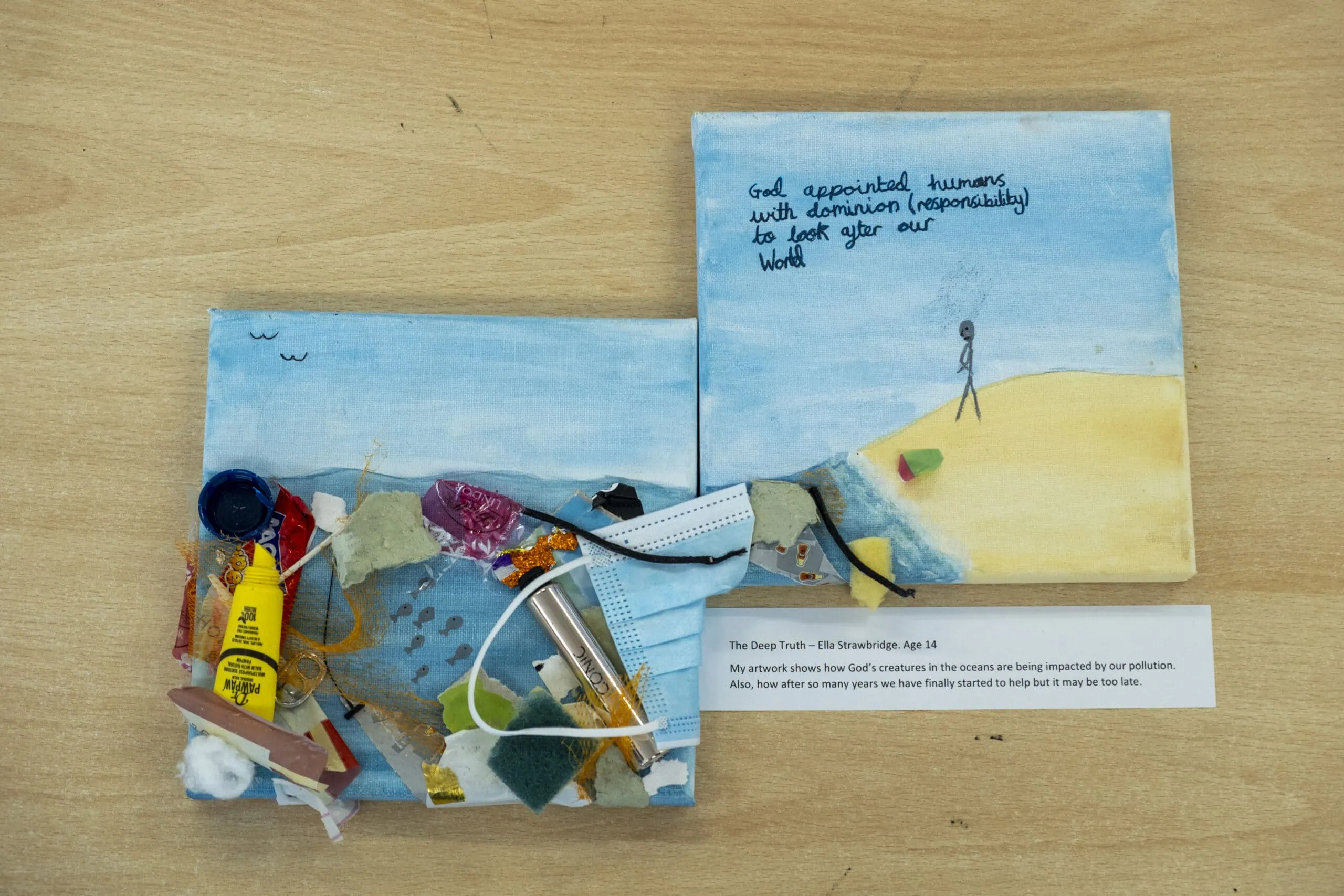
My artwork shows how Gods creatures in the oceans are being impacted by our pollution. Also, how after so many years we have finally started to help but it may be too late.
Christchurch Primary School
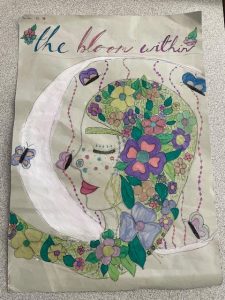
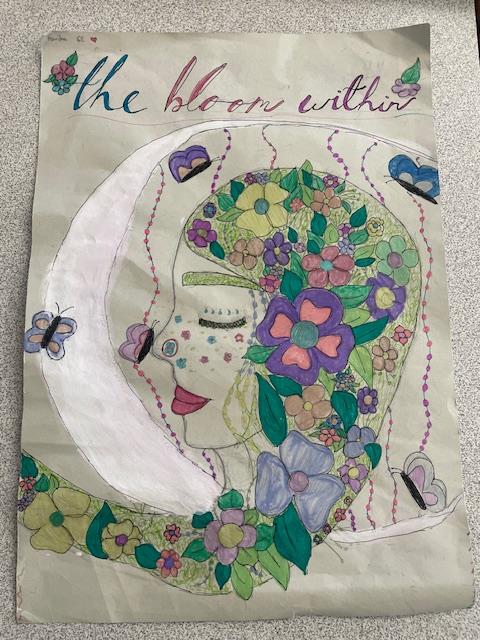
My ‘The bloom within’ work is about God’s creatures. It shows the beauty of the plants and women all in one. Doing this work made me think how cruel the world is by destroying all of these divine things. In my picture, you can see a girl, closing her eyes with a precious, delicate butterfly on her nose and some flowers and plants in her hair. This is because she is admiring the plants and greenery all over the world. I named my drawing ‘The Bloom Within’ because the flowers and plants remind me of Kew Gardens, I remember that when I saw the flowers in Kew Gardens, it made my heart bloom instantly.
South Wilts Grammar School
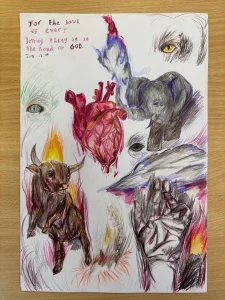
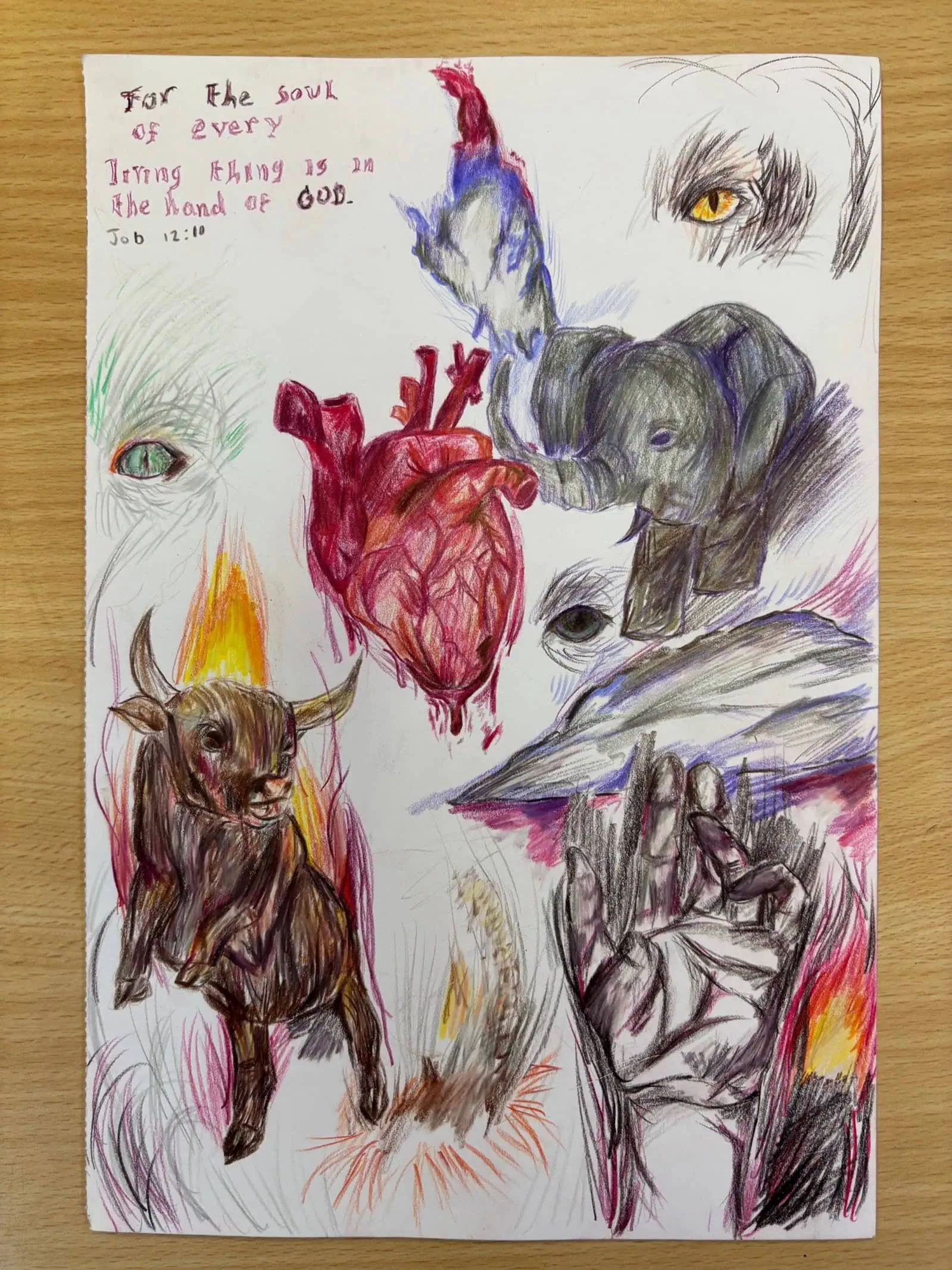
I chose this theme because of my deep connection with animals. All my life I have grown up around them, and the many stories and experiences I’ve had with animals have truly inspired me. One passage from the Bible that is especially meaningful to me is: “For the soul of every living thing is in the hand of God.” (Job 12:10).
The hand in my artwork represents this idea, God guiding all creation without interfering. The bull in my piece symbolises strength, virility, and power. The water sprayed by the elephant begins as something pure, but it slowly bleeds red into something deeper and more complex, showing that even what is pure can be negatively influenced. It shows how one creation can have a huge impact on the world around it.
My elephant represents wisdom, protection, and prosperity, and this protects it against the bull’s anger. This shows that light can outshine darkness, and that if God creates something powerful or dangerous, He also provides balance and peace.
The eyes in my artwork are cat eyes. Eyes are a gateway to the soul, symbolising truth and awareness. The cat’s eyes also convey intuition and sensitivity, helping reveal the true divine nature within creation.
Finally, the human heart in the centre symbolises the seat of life; our core, where everything connects.
Grove Park School
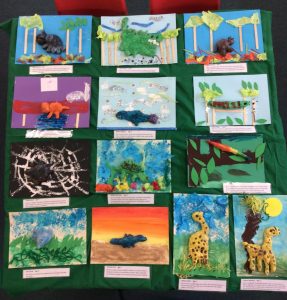
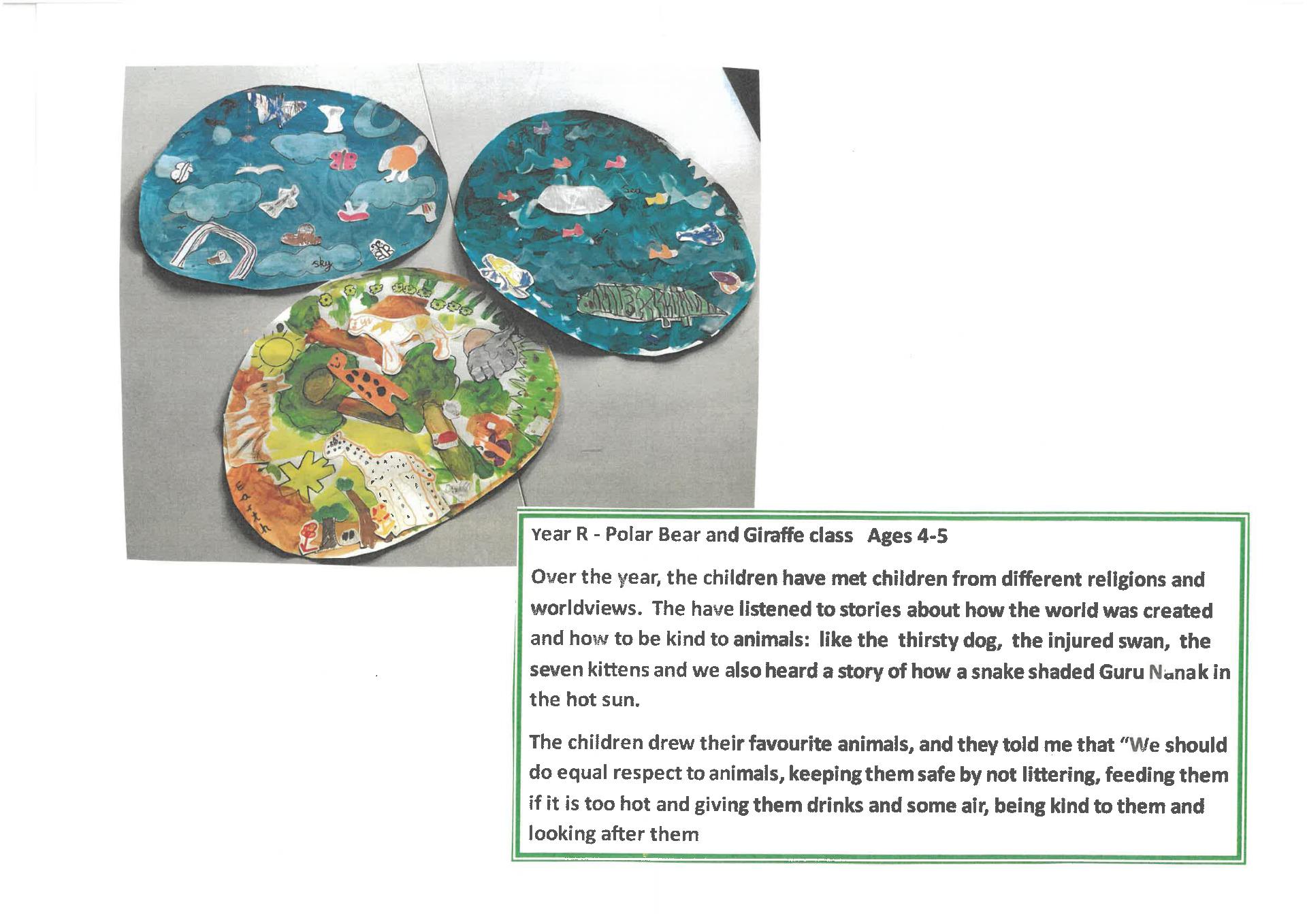
Over the year, the children have met children from different religions and worldviews. The have listened to stories about how the world was created and how to be kind to animals: like the thirsty dog, the injured swan, the seven kittens and we also heard a story of how a snake shaded Guru Nanak in the hot sun.
The children drew their favourite animals, and they told me that “We should do equal respect to animals, keeping them safe by not littering, feeding them if it is too hot and giving them drinks and some air, being kind to them and looking after them
Christchurch Primary School
My title for this artwork is ‘Beautiful World, Fading World’. I chose this title because I find that it truly embodies the message that our world is so amazing and special but is fading quickly as we fail our duty to look after all the creatures that trust and count on us to keep them safe.
This topic is deeply important to me and for years now, this topic has been troubling me more and more. Growing up, I heard stories, I watched them on TV and I learnt about them in school and I always dreamt of these majestic creatures and the respect they must be receiving. But as time went on, I discovered the harsh reality, a heart-breaking truth that I was determined to stand up to and this artwork has given me the chance to do just that.. Animals aren’t respected in our community, they are tortured, driven away by humans, slaughtered for our own benefit. This artwork was inspired by my trip to India in which I saw for myself these beautiful creatures and knew something had to be done. Over the years, I’ve heard people talk about animals in many different ways, some in awe but most treating them as if they were nothing other than pawns in a bigger game. But animals have a soul just like us and they are nothing but equals; another creation of God. So I wrote this poem to show all the haters the real truth.
If you take a closer look at the faded picture in the background, you will notice the chains on the elephant, an elephant who has no choice but to give in to our torture. These chains symbolise the cruelty that we have brought upon them. They have struggled for so long but they don’t deserve it. On the outside of my picture, there are religious quotes from the Bible that prove my point from another point of view. Don’t you feel bad, seeing the skins of these innocent animals, knowing that they have done nothing wrong.
I wrote this poem to showcase the beauty and love that these creatures deserve and how they are treated instead, how we treat them. Our actions are unjust and cruel and everyone should realise this. I want to show the world this bitter truth so others stand up with me. I truly hope that my artwork inspires people to stand up for what’s right and that they too embrace animals as equals, never slaves. I want others to realise the pain we have created but also for them to know: it isn’t too late. There is still a chance. Still a way to save them. If only you try…
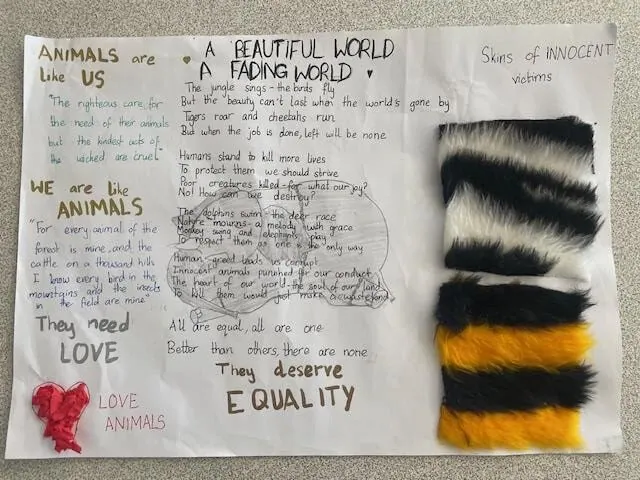
The jungle sings, the birds fly
But the beauty can’t last when the worlds gone by,
Tigers roar and cheetahs run,
But when the job is done, left with none.
Humans stand to kill more lives,
To protect them we should strive,
Poor creatures killed – for what our joy?
No! how can we destroy.
The dolphins swim, the deer race,
Nature mourns, a melody with grace
Monkeys swing and elephants play
To respect them as one is the only way.
Human greed leads ‘us’ corrupt
Innocent animals punished for our conduct
The heart of our world, the soul of our land
To kill them would just make a wasteland.
All are equal, all are one
Better than others, there are none
They deserve – EQUALITY!
St Peter and St Paul C.E. Primary
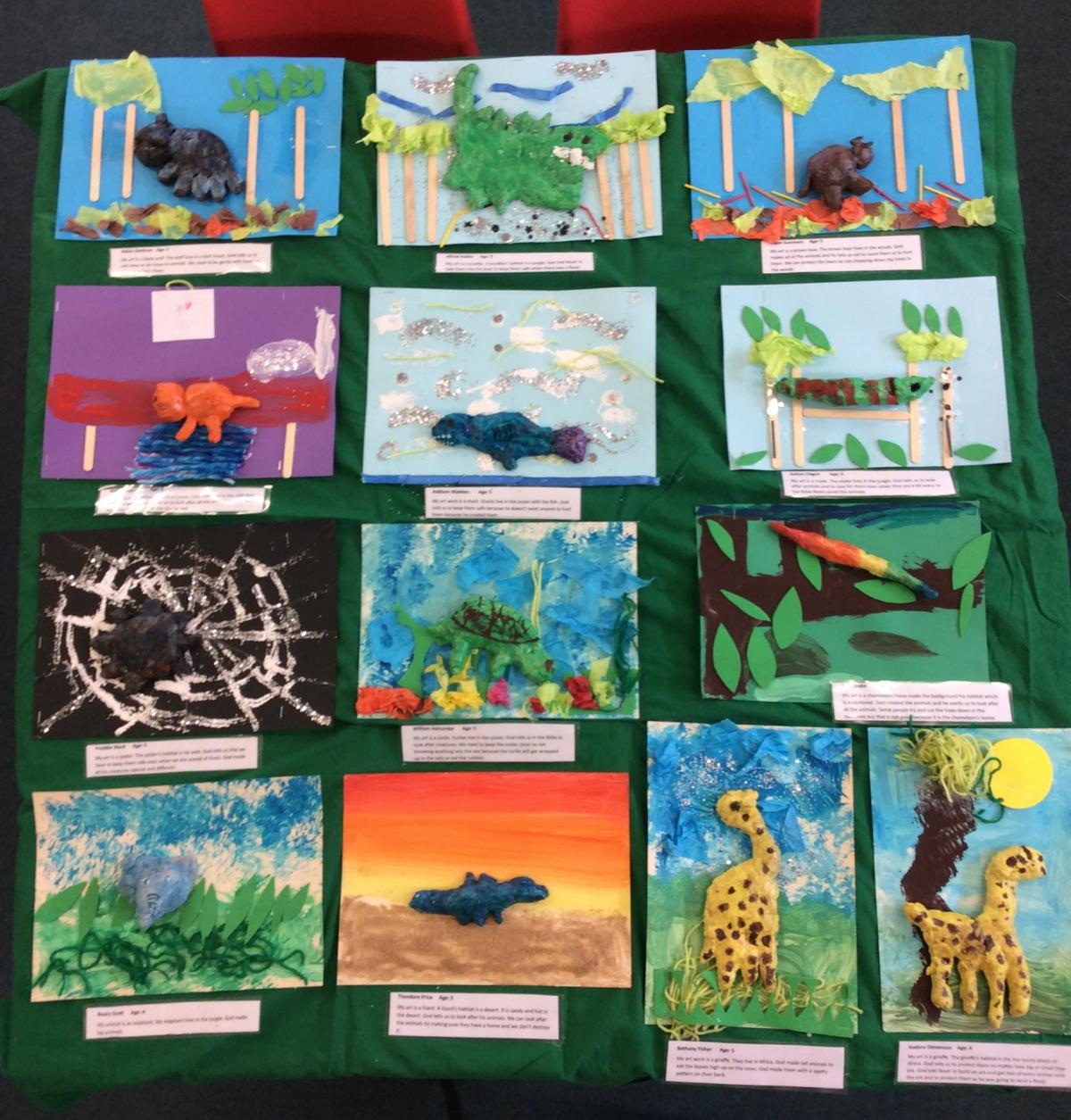
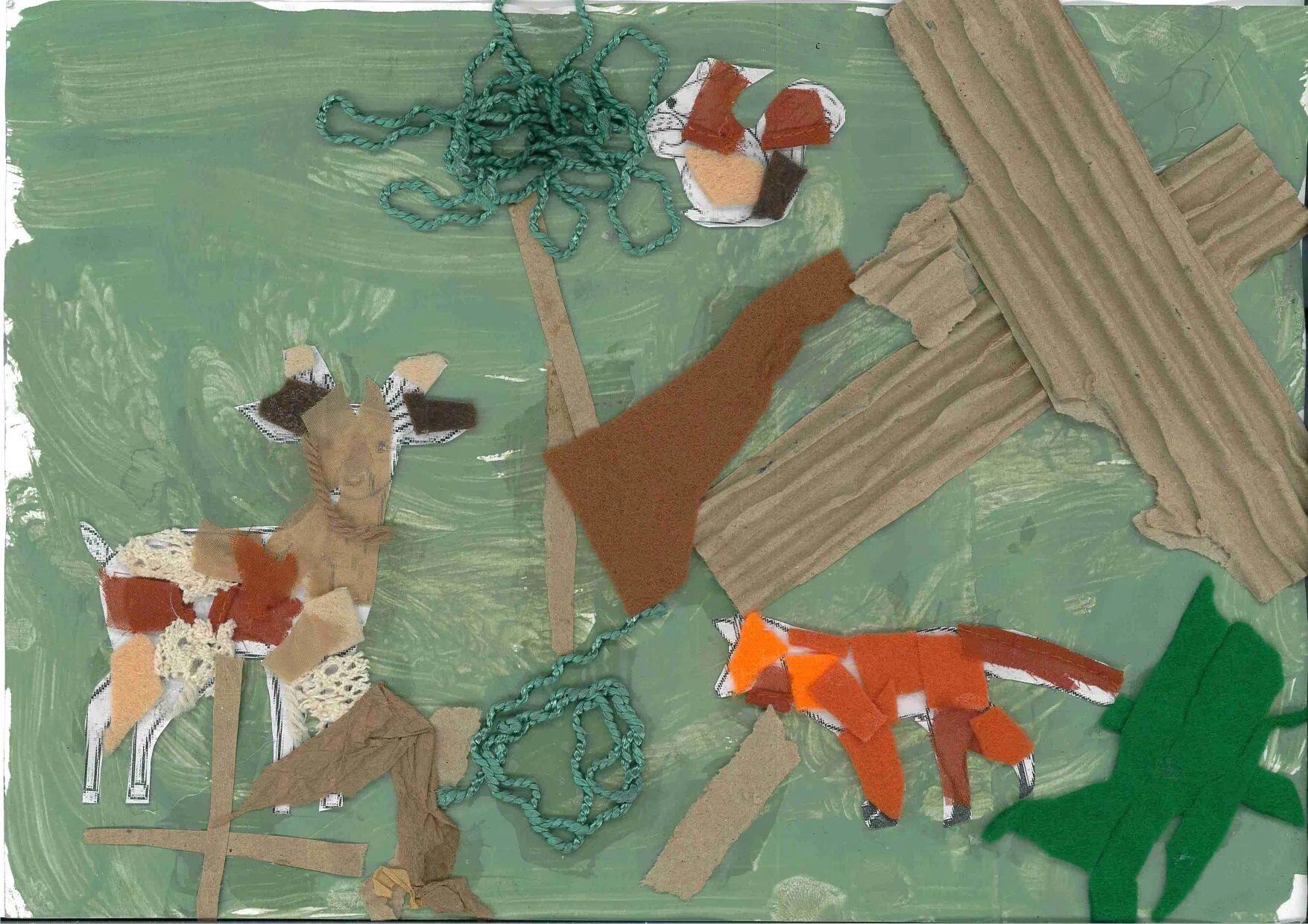
I made animals in a woodland because they live in our country. I’ve only seen a deer, it was running. I think animals belong to God because God made them because he likes them. We can look after animals by not throwing litter on the floor because they might get stuck. Animals make me happy because I like the colours of them.
Neston High School
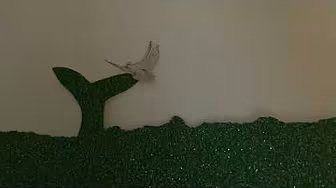
For my project, I created a stop motion video made up of more than 600 images. All the scenes and animals were drawn by me. It starts with God creating the world as all animals need somewhere to live. Then it shows the sea animals, I focused on the whale from the story of Jonah and the whale. For the birds of the air, I focused on the dove as it symbolises the holy spirit – peace and hope. The last part shows the animals on land and when God created Adam and Eve and put them down on Earth with the animals.
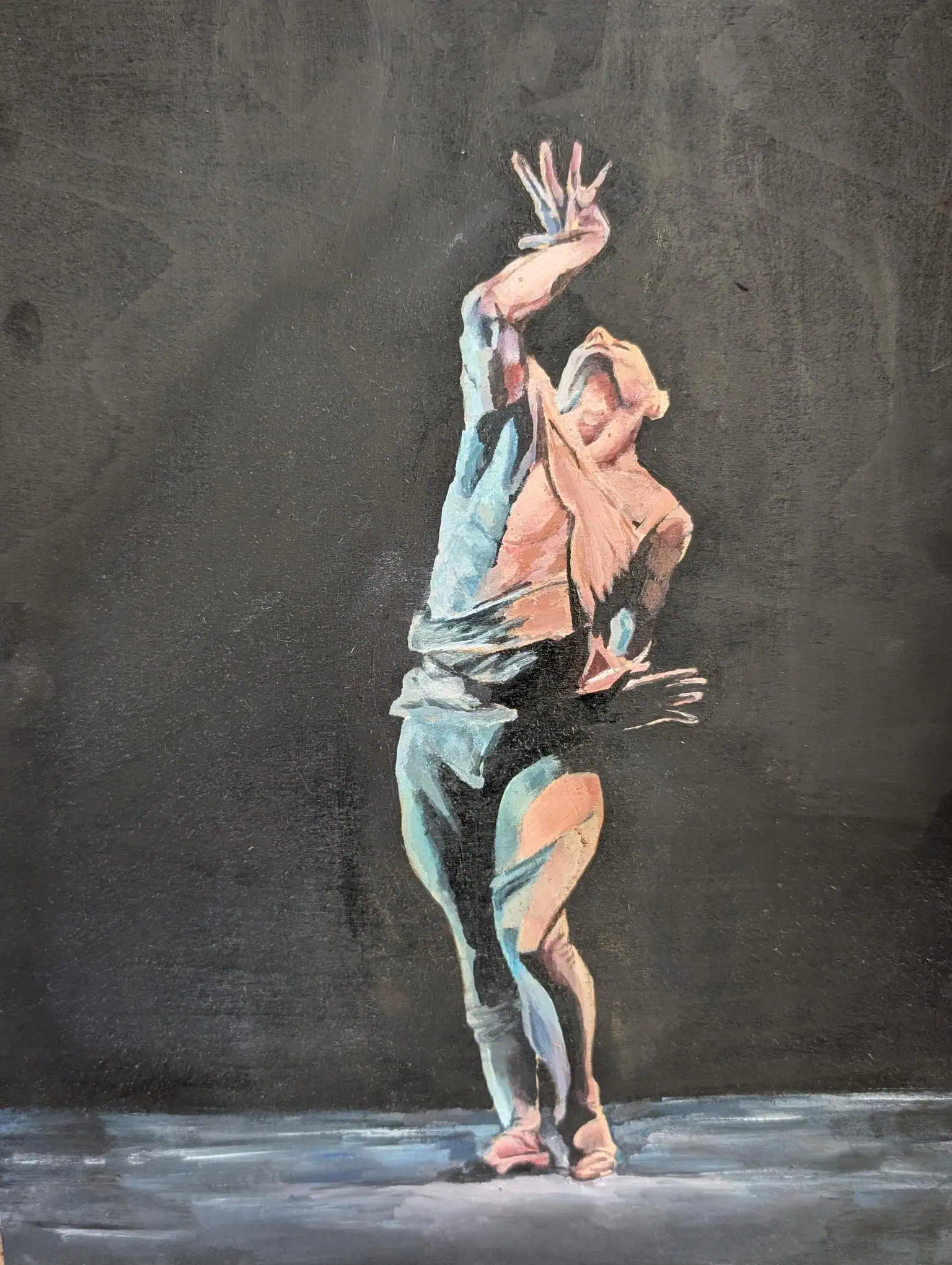
Macey – Age 17 – Within us and Around us
Becket Keys Church of England School
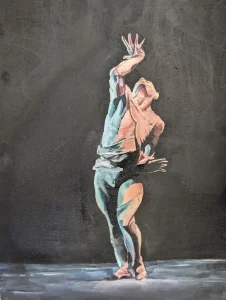
Within this piece I wanted to capture the human form in all its beauty, movement tones and shapes. The person is in a dark space but they bring light and life just as God did. We are one of God’s many creatures and one that can protect and help others thrive. My painting conveys strength, courage and life coming from the dark.
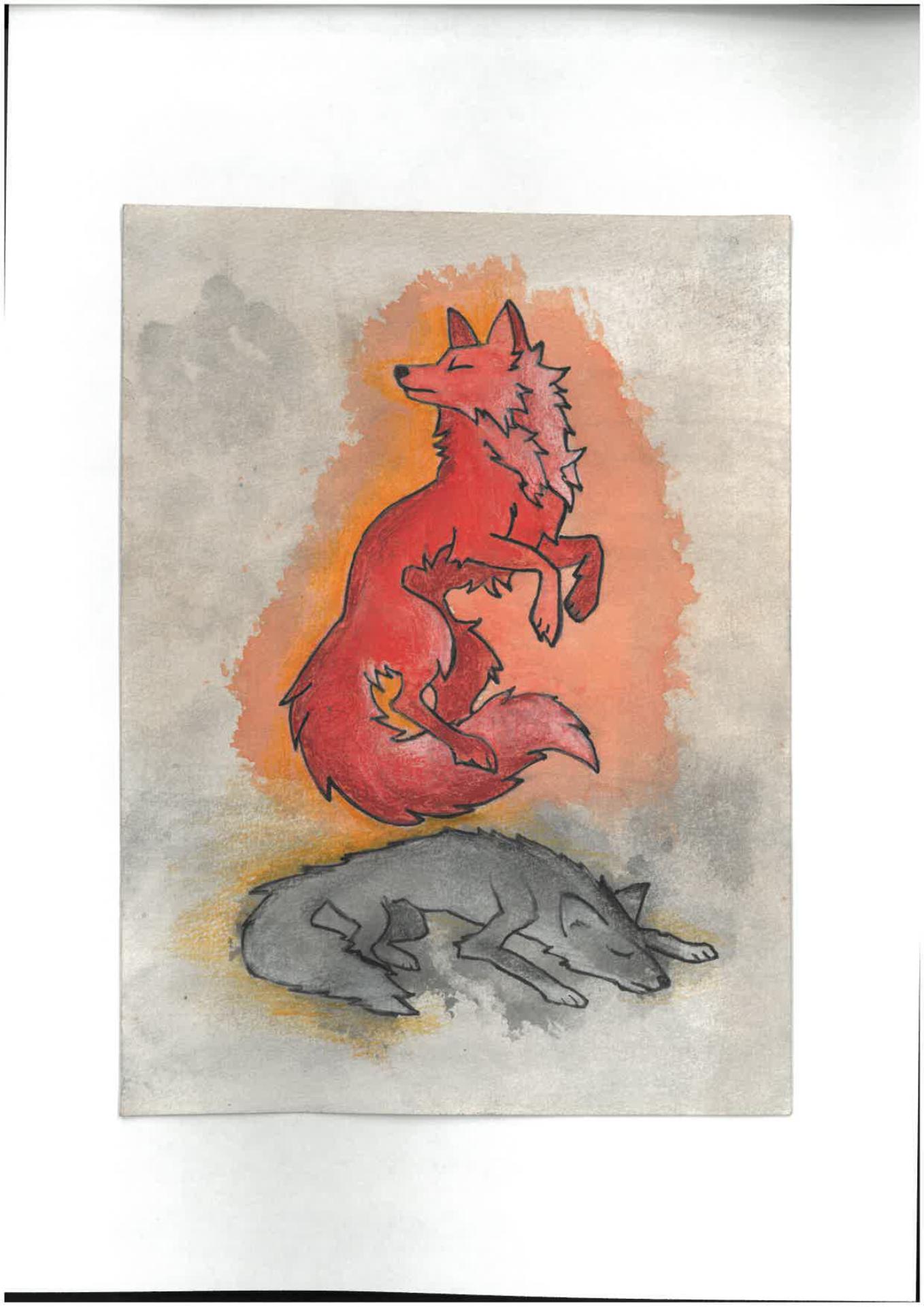
Solihull School
Foxes are often seen as cunning, sly or evil… what if there’s more?
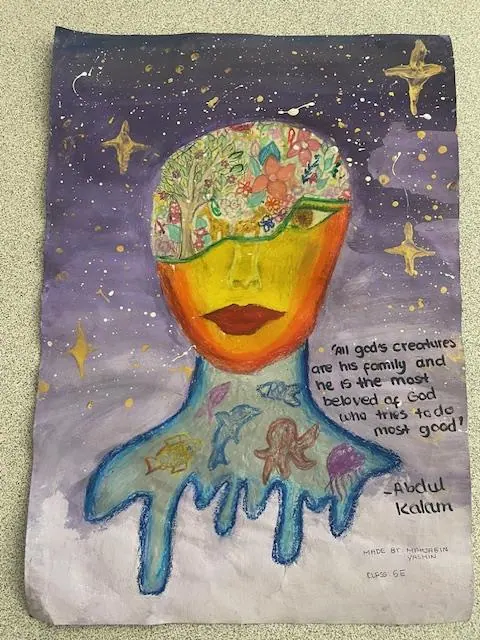
Mahjabin – Age 11 – A Creature of God
Christchurch Primary School
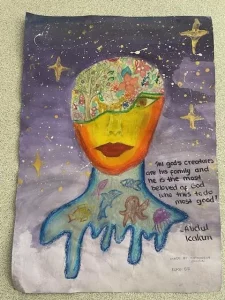
My picture is made out of three elements: fire, water and earth. The topic my picture is based on is all of God’s creations. It also shows the habitats of different creatures – some which live in the sea and others which live on land. I have chosen a purple background with golden and white sparks because purple symbolises peace and tranquillity. I have also written a quote stated by Abdul Kalam in my artwork – ‘All God’s creatures are his family; and he is the most beloved of God who tries to do the most good to God’s creatures’. This quote tells us that we should all treat animals in a kind manner and not slaughter or hurt them. They are one of the wonderful creations of God.
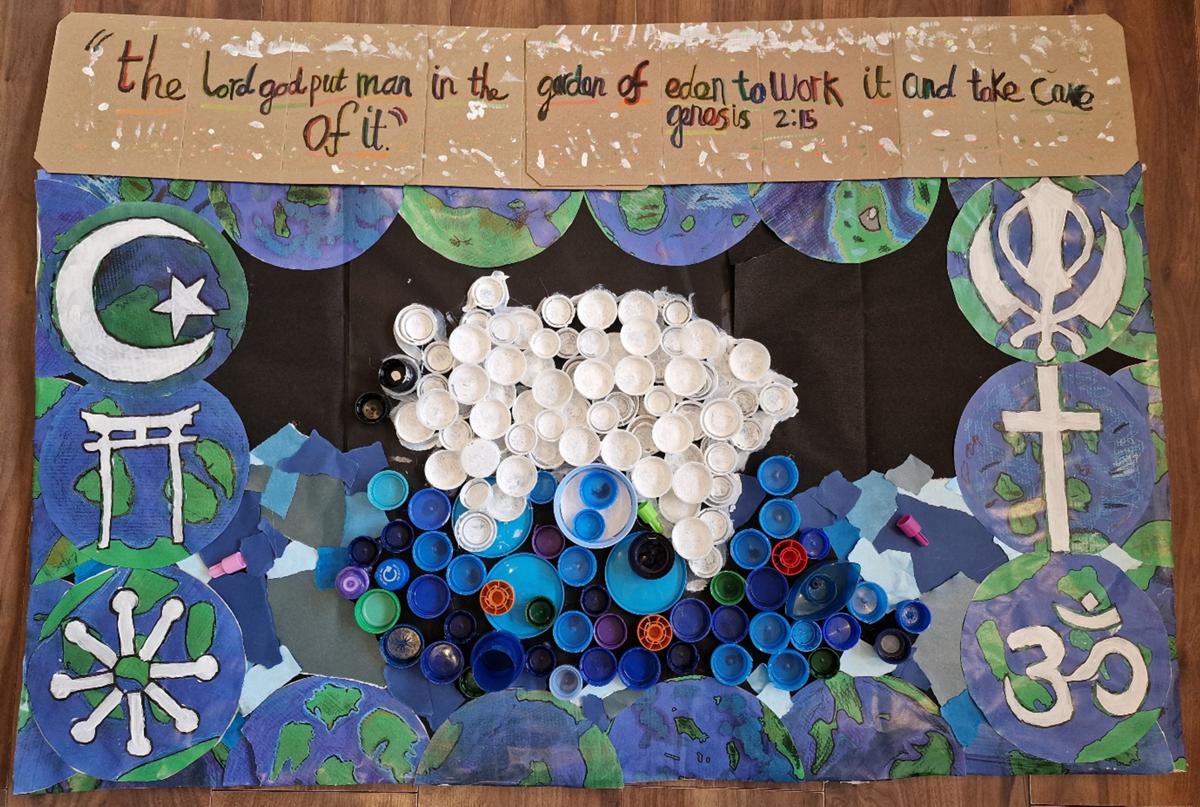
Eco-Committee – Ages 6-11 – All God’s Creatures
At Parkend Primary School, our values are ‘PACE‘: Pride in ourselves; Achieve the best we can; Curious thinkers; Everyone together.
The title we chose is ‘A Prayer for Tomorrow’ because we hope that all humans will keep trying to protect the future of all living creatures who share this planet with us. We can do this by being ‘curious thinkers’ as well as ‘achieving the best we can’ to save the animals.
Our picture is all about how pollution and climate change are affecting innocent animals. To make the image, we used cardboard and plastic. By recycling bottle tops to make the polar bear and the melting ice caps, we are showing our commitment and responsibility to saving the planet and taking care of all the creatures in it.
Many religious and non-religious people view pollution and waste as a moral and spiritual problem.
The quote we have included is from the Christian Bible: Genesis 2:15 “The LORD God put man in the Garden of Eden to work it and take care of it.” because it links to humans protecting our precious planet. We have included some other religious symbols to show we have learned about different viewpoints too. For example, Hindus believe that all living things have a soul and this soul is part of Brahman (their divine God). To rejoin with Brahman you have to treat all creatures with respect and care. In Islam, they teach people to sustain natural resources because it is a duty to God. Some of our club members are vegans and they also share the same respect for animal life so we wanted to show this in our artwork too.
This project has helped us see that no matter what belief you have, we are all responsible for our impact on the world and the animals that live in it. We need to have ‘’pride in ourselves’ through the choices we make.
By bringing ‘everyone together’, we can address climate change and environmental harm to all living things!
Class 5 – All God’s Creatures
Dedham Church of England Primary School
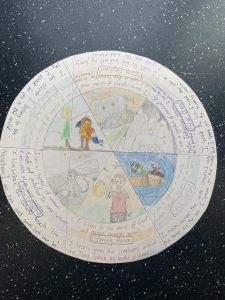
Class 5 have been learning about the Sikh faith. Pupils learned that Sikhs believe in the atman – the soul- which is a ‘divine spark’ given to all living creatures by Waheguru. They also learned that Sikhs believe in reincarnation, meaning a soul may have been reborn up to 8.4 million times as different life forms before being reborn as a human, in which form the soul has an opportunity to escape the cycle of Samsara and be reunited with Waheguru. Pupils discussed the concept of karma, and whether our judgements on ‘better’ or ‘worse’ animals as which to be reborn were justified; for example, just because we may not like slugs, does this mean that they were of less value to Waheguru who created them, and gave them a role to play in the world? Pupils read verses from the Guru Granth Sahib to understand the value placed on all life and the awe and wonder with which Sikhs regard Waheguru’s creation. Through a collage of animals in the shape of a human, pupils represented the diversity of animal life which an individual may have been part of in previous incarnations, showing the journey of the atman. Pupils also read in the Guru Granth Sahib about the Sikhi belief in Waheguru’s awesome creation of the whole universe, of which humans and the animal world are an integral part, and backed their collages on an abstract representation of space. Pupils discussed scientific ideas about whether life came to Earth from space, as there is evidence for organic molecules in meteorites, and how such variety of animal life came to develop on our home planet. They respectfully compared Sikhi beliefs in the ‘divine spark’ of Waheguru in all living things with their own beliefs about the creation of animals, which ranged from a tradition Christian understanding of God’s role as a creator, to non-religious perspectives about evolution. They also considered the idea that people of faith can also believe in scientific origins of life, and the possibility that the diversity of animal life on earth may be evidence of both evolution and the work of Waheguru, God, or another supreme creator.
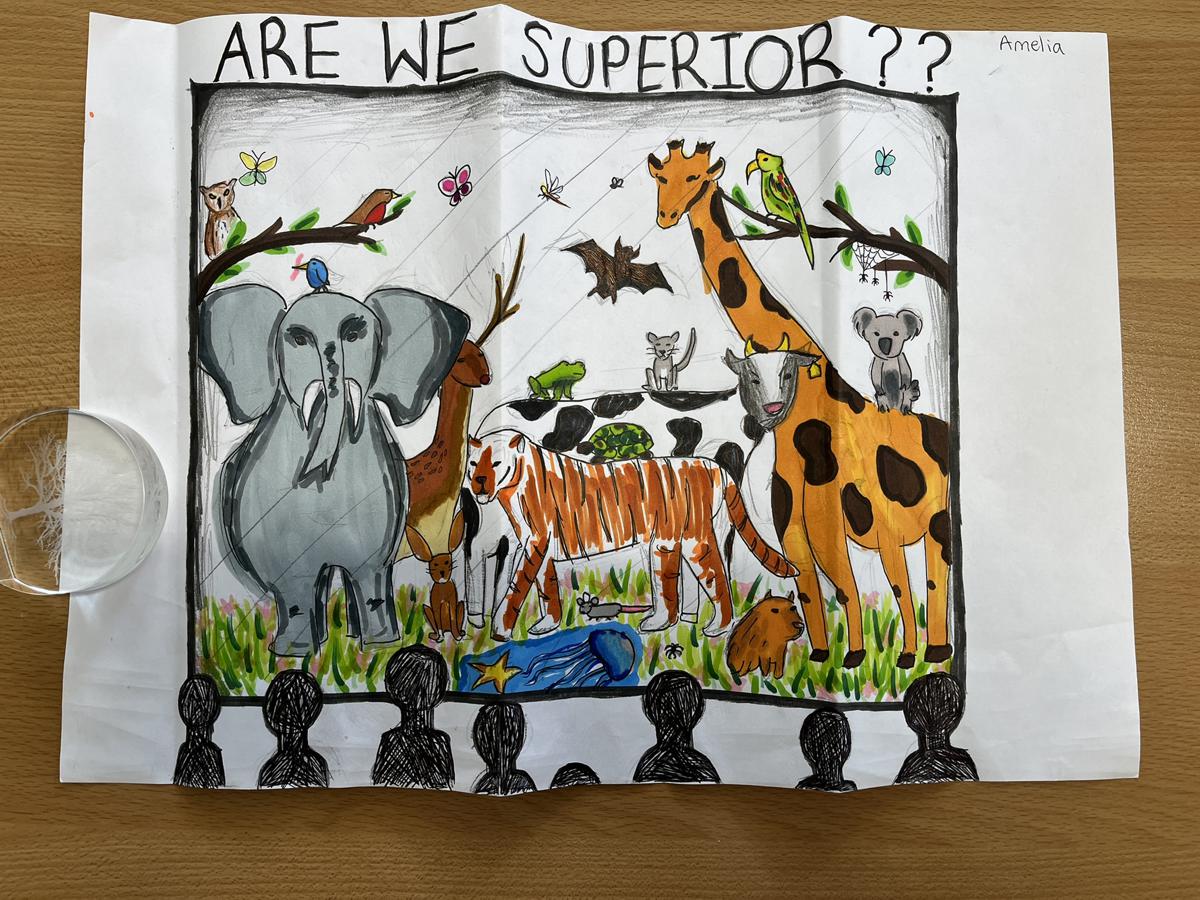
I chose to do ‘All God’s Creatures?’ because the theme is very important to me, because animals are beautiful, smart and they have feelings. They are all very different in their own ways and they should be treated with respect.
I had the idea to put lots of animals together in a big picture with the border around them representing animals captured in zoos and then silhouettes of people watching them from the outside.
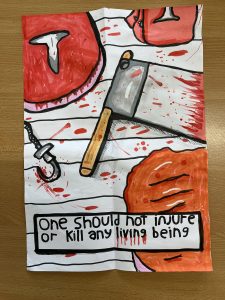
If we are all God’s creatures then why are we treating animals as if they are below us? We use them for entertainment, hunt them, use their skin’s for clothing and farm them for food. Millions of animals die creating things that we don’t necessarily need. At least 16 trillion animals are killed and made to suffer because of human actions. More than 55 billion land and sea animals die to support the US food supply.
Hunting and our destruction of the environment means many animals are now endangered such as the Amur leopard, African forest elephant, black rhino, Sunda tiger, orangutans, and some species of turtles.
Several religions include limiting or abstaining from eating meat such as Buddhism (not all Buddhists are vegetarian, but many have vegetarian or vegan diets) and Hinduism (many Hindus avoid meat but can consume dairy). However, people of all religions, and those with no religion, can choose to be vegetarian or vegan if they want to help animals.
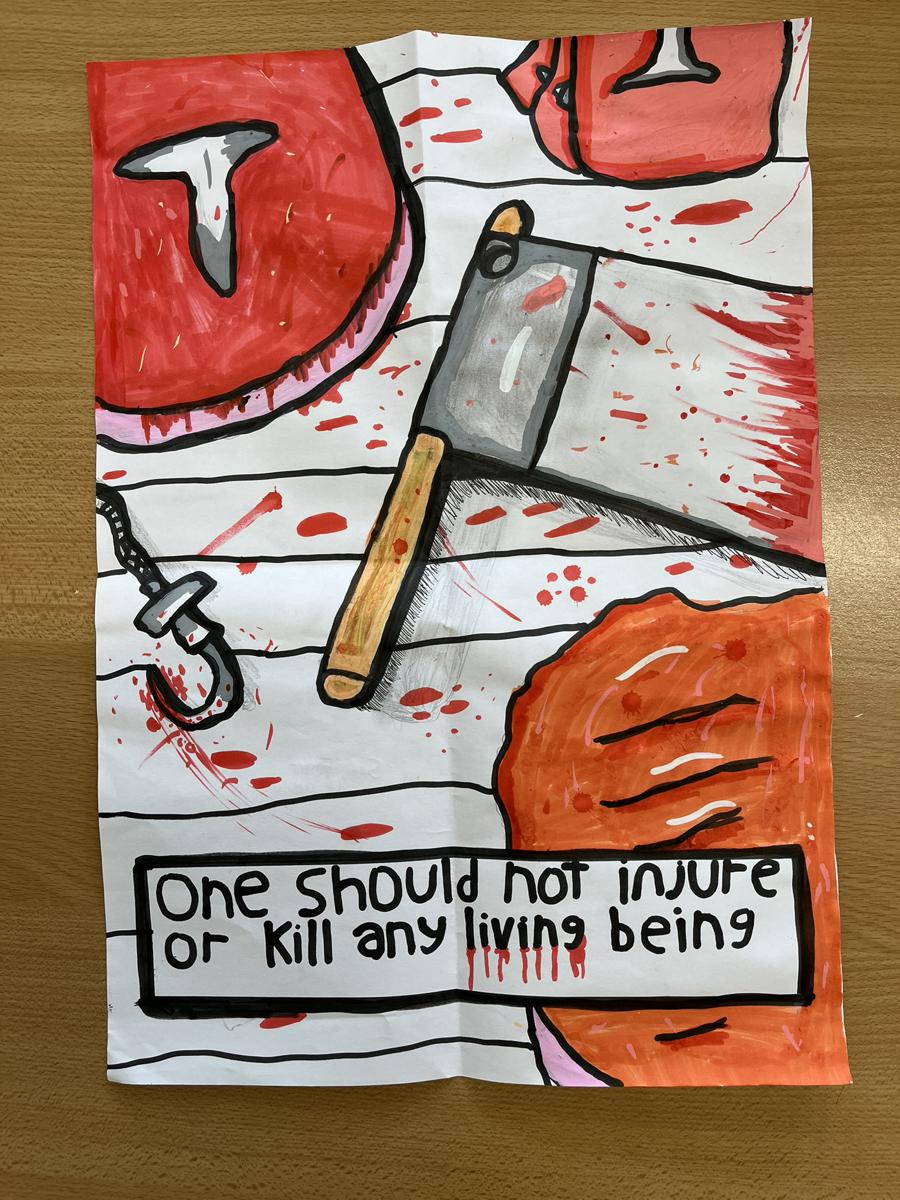
This piece represents how animals are slaughtered every day for people to eat, and sometimes their meat is even wasted. The message I want to convey is that people need to show more sympathy towards animals and value their lives more. Animals have emotions, raise families, and can feel pain and fear.
My piece relates to a vegan point of view as vegans believe that killing an animal is wrong and would rather see a chicken alive than ordering a slaughtered one from KFC.
I have chosen this theme because even though I’m not vegan, I respect their point of view and think it’s important to value an animal’s life.
Year 2HC – The Listening Human
NCEA Bishop’s Primary
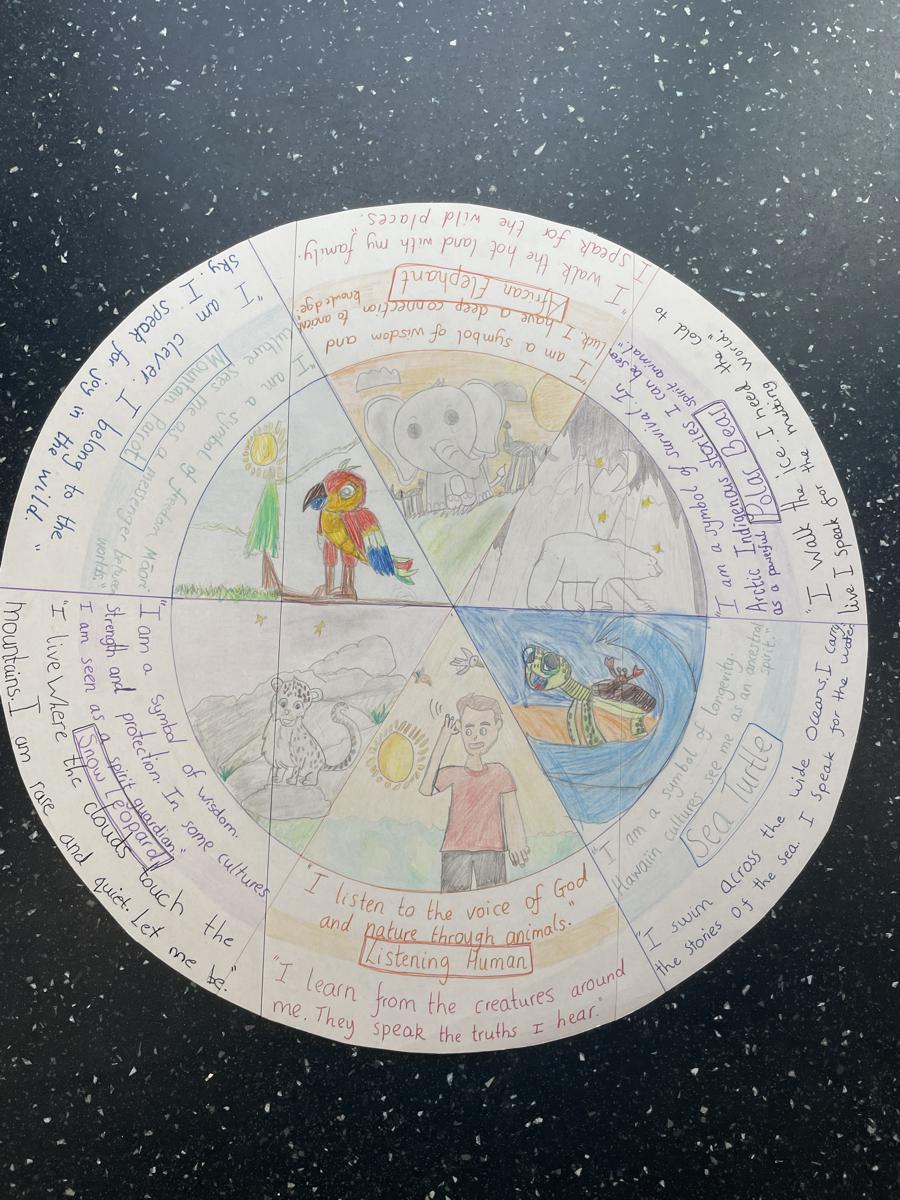
We have created a piece of artwork which explores the relationship between humans and the animals with whom we share planet Earth. We have drawn 5 animals who live in different places in the word and in different parts of the natural world (land, sea and sky). These animals each have a meaningful link both to different non-religious climate issues and to different religious, cultural and spiritual beliefs.
As well as the 5 animals, the artwork features a ‘Listening Human’. He is listening to the imagined words that these animals would share with humans if they had the opportunity to explain their place in the natural world- how they wish all humans would interact with them, celebrating them and respecting their habitats. The artwork aims to make people realise how interconnected animals and humans are and how we should learn from, celebrate and protect them.
Climate Issues addressed- how these animals’ habitats/lives are being threatened
Polar Bear and snow leopard- global warming.
Sea turtle- climate change’s impact on the oceans, ocean pollution.
Elephant– poaching.
Mountain parrot- deforestation
Religious, cultural and spiritual themes addressed
Polar Bear- powerful spirit animal in Inuit and Arctic indigenous stories and legends
Snow Leopard- seen in some Himalayan cultures as a spirit guardian
Sea Turtle- seen in some Hawaiian cultures as having spiritual links to creation and ancestors.
Elephant– spirit animal with a deep connection to family and ancient knowledge- can guide people through life’s journey.
Mountain Parrot- seen by some Maori cultures as messengers between worlds (including messengers for gods).
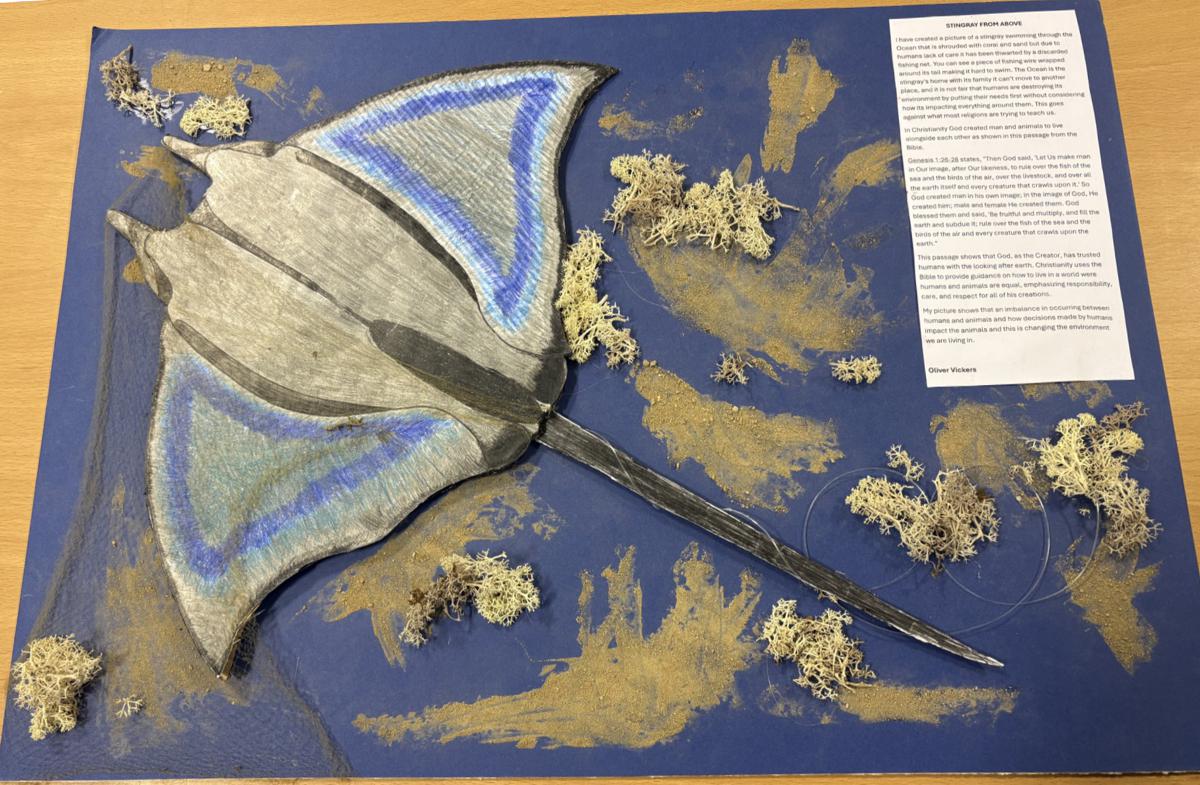
Oliver – Age 11 – Stingray From Above
Parrenthorn High School
I have created a picture of a stingray swimming through the Ocean that is shrouded with coral and sand but due to humans lack of care it has been thwarted by a discarded fishing net. You can see a piece of fishing wire wrapped around its tail making it hard to swim. The Ocean is the stingray’s home with its family it can’t move to another place, and it is not fair that humans are destroying its environment by putting their needs first without considering how its impacting everything around them. This goes against what most religions are trying to teach us.
In Christianity God created man and animals to live alongside each other as shown in this passage from the Bible.
Genesis 1:26-28 states, “Then God said, ‘Let Us make man in Our image, after Our likeness, to rule over the fish of the sea and the birds of the air, over the livestock, and over all the earth itself and every creature that crawls upon it.’ So God created man in his own image; in the image of God, He created him; male and female He created them. God blessed them and said, ‘Be fruitful and multiply, and fill the earth and subdue it; rule over the fish of the sea and the birds of the air and every creature that crawls upon the earth.”
This passage shows that God, as the Creator, has trusted humans with the looking after earth. Christianity uses the Bible to provide guidance on how to live in a world were humans and animals are equal, emphasizing responsibility, care, and respect for all of his creations.
My picture shows that an imbalance in occurring between humans and animals and how decisions made by humans impact the animals and this is changing the environment we are living in.
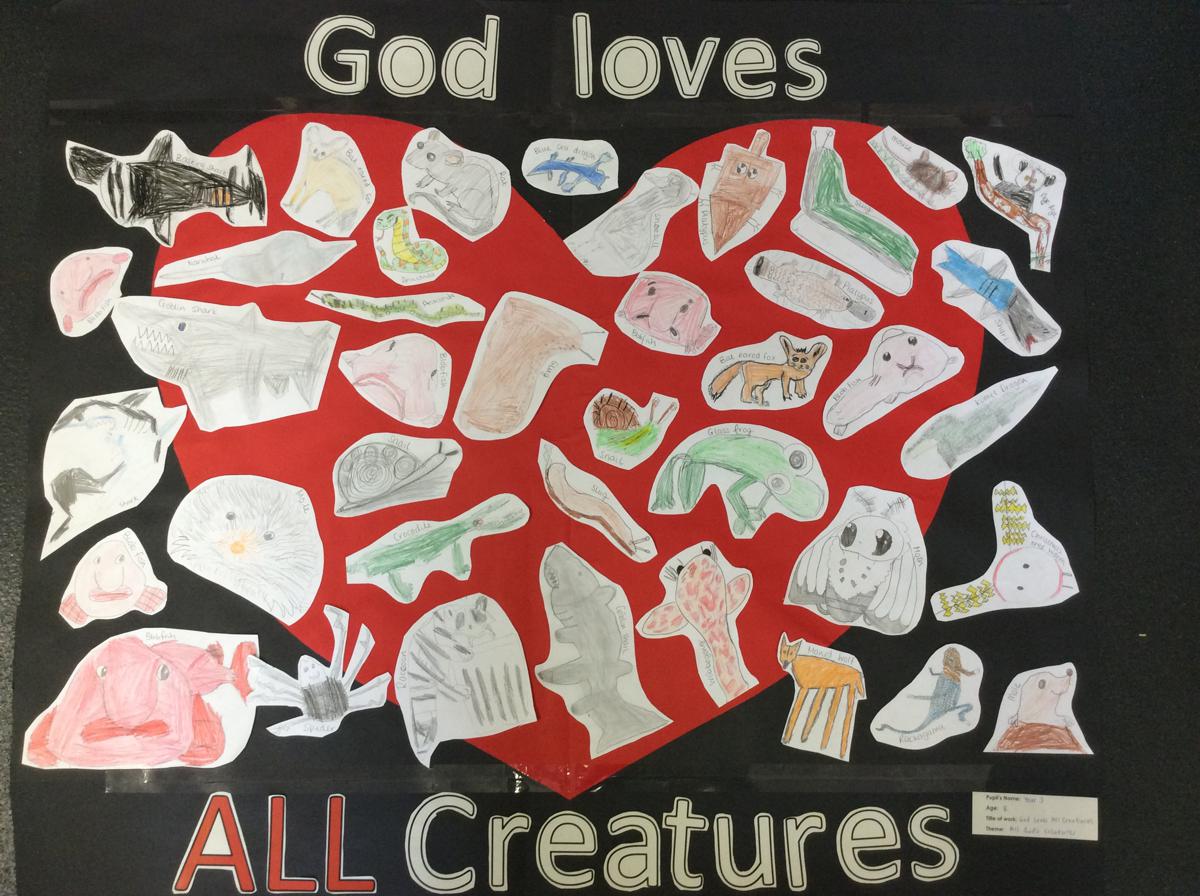
Year 3 – Age 8 – God Loves All Creatures
St. Paul’s C.E. Primary School
For our Spirited Arts day we focused on the bible story ‘Noah’s Ark’. We looked at videos and artist depictions of the story and noticed that it was always the same animals included. We then discussed why it’s always giraffes, lions, elephants, dolphins etc that are usually included. The class thought:
“Because they are cute.”
“Because they are everyone’s favourites.”
We then asked the question, what about the animals that people are scared of? What about the weird animals that people don’t like? Does God love these animals? Do they deserve the same respect and care?
We looked at Bible Verses that explain that God does indeed love ALL animals. We also looked into other religions such as Hinduism, where they believe in reincarnation, so all life is important.
This led us to research all the wonderful creatures that deserve just as much love as typically ‘popular’ or ‘cute’ creatures.
We believe that all animals, no matter how small or weird, should be loved the same and cared for the same, as God would have wanted us to.
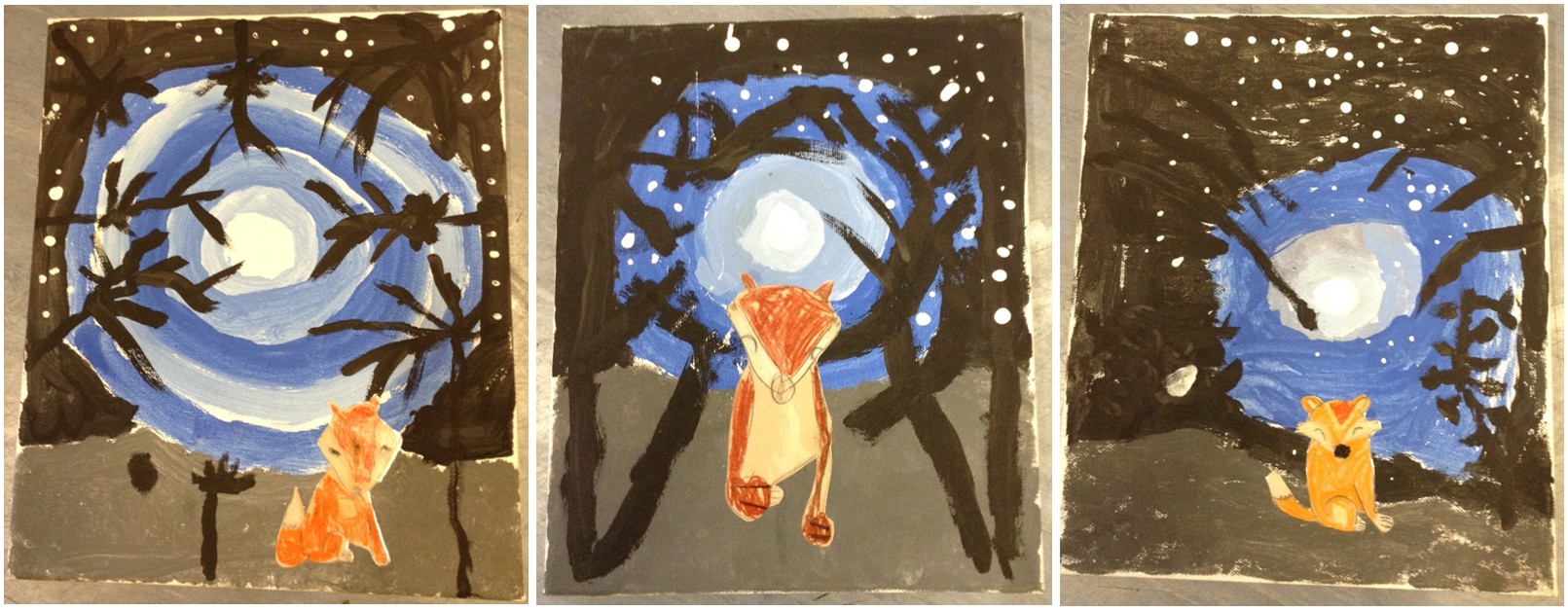
Year 1 – The Fox and the Star
St. Andrews CE Primary School
Year 1 explored the story of “The Fox and the Star” by Coralie Bickford-Smith.
We discussed the idea of stars being a guide in the dark and the emotions fox would feel when he was in the dark, and then once the stars came together and lit his way at the end. We discussed The Christmas Story and the links between the two stories in that the star is a guiding light that leads us to where we need to be and is a constant source of comfort.
As part of our English we talked about the features of the fox, both how he looked so we could use this detail in our artwork. As well how he felt to deepen our understanding and use our own emotions in our piece.
We started by creating shades of blue paint for the moon ring effect on canvas. We then added the grey ground by botting, and the silhouette trees with acrylic paint to help it stand out. We used the wrong’ end of the paint brush to create the star effect. Finally we sketched the fox and coloured using oil pastels in different shades to create a textures fur effect.